Everything that takes place in today's times, needs to take into consideration a lot of factors. These factors are not only related to the field they belong to or are from a technical point of view but are much more important and necessary than that. The environmental factor comes to mind. It is important to take steps that do not affect the environment in any way but performs their purpose without causing much harm to the environment or causing minimal damage to it, if at all.
Reasons for the environmentalist demand to get Bitcoin to follow Ethereum's footsteps
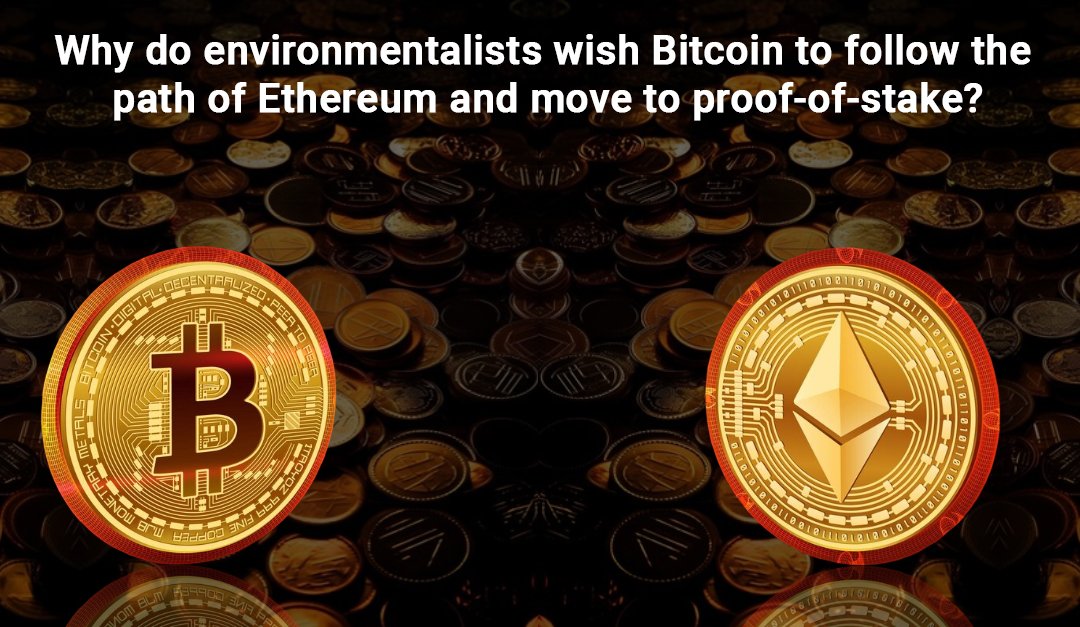
To understand why the environmentalist is dead set on making a bitcoin shift, one first needs to understand the path that Ethereum has followed that has quite impressed the environmentalists. The transition of the Ethereum blockchain form that of proof-of-work to proof-of-stake has taken a huge step in the preservation of the environment. It has saved almost up to 90% of the electricity it used to consume before. Therefore, it has raised a similar demand to pursue Bitcoin to follow the same track.
What are the steps taken to urge Bitcoin to follow suit?
After the merge took place, the Environmental working group made an announcement that was to make Bitcoin follow the path of Ethereum. In this announcement, it was stated that the EWG or the Environmental working group would be commencing a campaign worth one million dollars to make Bitcoin follow this path. It would urge Bitcoin to take up green initiatives or measures and to let go of its systems that have already been quite outdated. One example of it is the usage of the PoW. This is not a new concept that the EWG came up with.
Before the campaign against Bitcoin, a similar event has taken place in which the Greenpeace community, launched a petition against Fidelity Investment to get them to adopt the PoS. They called for a transition immediately.
It was also stated by various leading figures of this green campaign that the various kinds of cryptocurrencies have been working by taking into consideration the several consensus mechanisms for years now. However, Bitcoin has decided to not adhere to any and has let go of the responsibilities it owes to the environment. It has refused to play its role in the preservation and safety of nature and its resources.
How has the merge helped the environment?
There have been various statements made by the environmental authorities regarding there and how it has helped in the preservation of the environment. The merger has helped in saving a lot of energy and has shown that digital assets, with a few necessary changes, would not need to take up the amount of energy they aid to take up before. It has paved the way for many crypto assets to follow and to bring about a new and better environmentally conscious world. However, all are looking forward to Bitcoin's next move in the same matter.
Conclusion
There have also been reports that have shown the negative side or setbacks of adopting a proof-of-stake system. It has even been stated that a comparison of the two, that is, of proof-of-stake to Bitcoin is rather futile and baseless. There have also been various lawmakers in the United States who have asked to suffer major Bitcoin mining agencies to come up with reports that show how much energy goes into the mining of Bitcoin. They need to show the amount of energy that is consumed, the sources from which they get energy as well as the percentage of energy that is derived from the renewables.
Maximalists in the Polygon [MATIC] community have been having a nice time as a result of the recent occurrence of a variety of new advancements on the network. Lark Davis, a reporter with cryptocurrency news outlet Crypto reporter, revealed that MATIC had reached two billion transactions in its existence.
This is very important news for Polygon, which has been one of the scaling solutions for Ethereum [ETH] that has performed very well. However, this is not the end of the story since transactions based on polygons are quickly catching up to and even passing Ethereum.
Definition of Polygon
Polygon is a scaling solution that operates beside the Ethereum blockchain and is referred to as a "layer two" or "sidechain." It enables transactions to be completed quickly and at a cheap cost. The native cryptocurrency of the network is called MATIC, and it is utilized for a variety of purposes including fees, staking, and more. Exchanges like Coinbase allow for the purchase and sale of MATIC.
What is meant by MATIC?
Polygon has its cryptocurrency known as MATIC, which is used for staking on the Polygon network, paying fees on the Polygon network, and for governance purposes (which means that MATIC holders get to vote on changes to Polygon). In addition, Coinbase and other exchanges make purchasing and selling MATIC possible.
During an early phase of Polygon's development, the company was known by the moniker MATIC. After first debuting as Matic Network in October 2017, the creators changed the name of the platform to Polygon in the early part of 2021.
Polygon vs Ethereum: Who is doing better in the market?
Despite this, Polygon's performance throughout this quarter has been better than Ethereum's. According to Polygon Daily, the scaling solution completed around twice as many transactions on average as Ethereum did during this quarter.
In addition, the network reportedly achieved a new benchmark for Polygon-based NFTs, as stated by the Twitter feed for Polygon news known as Polygon Daily. According to this tweet, the monthly sales volume of NFTs on Polygon achieved an all-time high of $100 million in August.
Since February 2022, when the company had its last greatest performance, this is the first time Polygon has been able to break beyond the $50 million resistance barrier. OpenSea, the biggest NFT exchange, has just made it possible for users to list native tokens on Polygon and buy them using those tokens.
Where does the market stand now?
Having said that, Polygon released a statement on September 5 stating that they have welcomed Senken to their team. Senken is a marketplace for tokenized carbon credits that operates on the blockchain and enables users to purchase, sell, and retire tokenized carbon credits. These are produced via on-chain carbon infrastructure and services built using Polygon's platform.
Where does MATIC intend to go?
After falling from its peak of $1 in August, MATIC was trading at $0.89 at the time of this publication. According to CoinMarketCap, the governance token used by Polygon saw gains of over 2% in the previous day, adding to the 5.2% increase it had had in the previous week. This puts Polygon in an excellent position to gain from the Merge since the increased scalability that Ethereum will experience as a result of the Merge will also be favorable to Polygon. Polygon's expansion, on the other hand, faces significant challenges from the development of L2 scaling solutions like Arbitrum and Optimism. There is a lot of speculation going around that these two procedures will be in the driver's seat when the L2 season rolls around again.
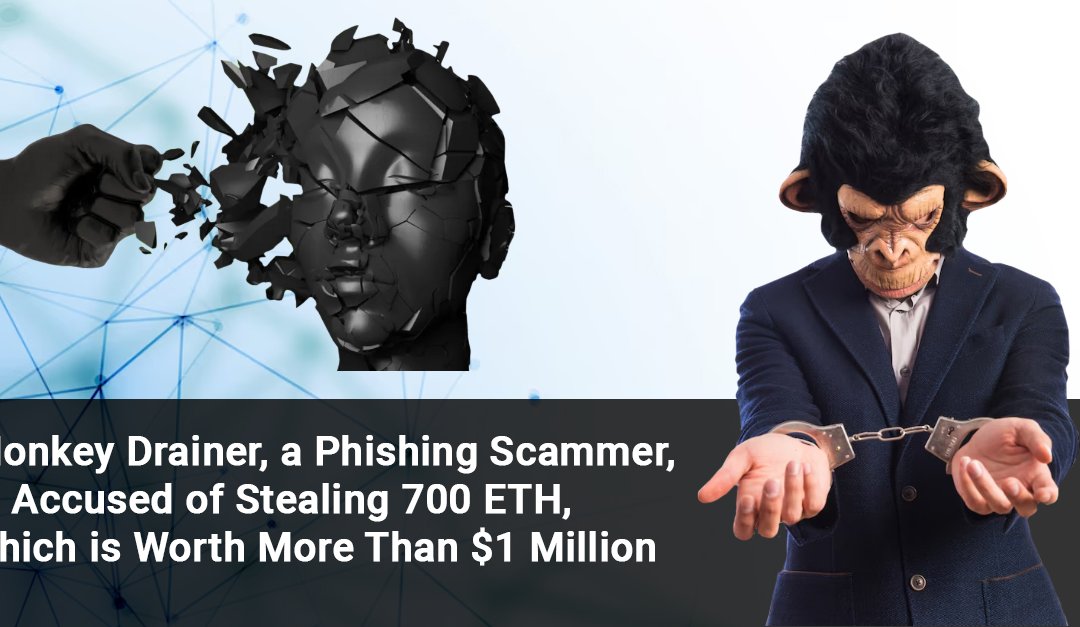
ZachXBT, a well-known on-chain investigator, claims that Monkey Drainer, a phishing scammer, has stolen over 700 ETH (equal to $700,000) worth of cryptocurrency and non-fungible tokens in the last 24 hours, amounting to about $1 million.
How did the Monkey Drainer Scam?
According to ZachXBT, the two biggest victims, 0x02a and 0x626, lost a total of $370,000 after approving transactions on phishing websites controlled by the serial fraudster. A total amount of $150,000 worth of non-fungible tokens (NFT) were apparently lost by 0x02a, including 1 Bored Ape Yacht Club (BAYC) collection, 1 CloneX, 36,000 USDC, and 12 additional NFT.
In the last few weeks, the suspected scammer has been successful in tricking several victims. The researcher claims that the amount of money stolen in the scam has exceeded $3.5 million and is continuing to rise.
Over 7,300 transactions have been performed by the hacker throughout his several months of operation.
APY, BMI, SHOPX, XED, and PMON, among other low-cap projects, were allegedly promoted by well-known crypto influencer Lark Davis before being dumped on the community's uninformed users, according to ZachXBT. He allegedly earned $1 million as a result.
Both of these victims were only a few of the numerous people who had their money taken by Monkey Drainer. According to a tweet from ZachXBT, more than $3.5 million has been stolen in total, and the figure is growing daily.
ZachXBT advised to the users to exercise "extreme caution" before linking their wallets to untrusted websites and signing transactions.
However, ZachXBT discovered a new phishing scheme in August when victims lost more than $2.5 million worth of NFTs. Five individuals associated with the BAYC collecting scheme were indicted in Paris earlier in October.
Phishing scams sometimes include criminals disseminating links to websites that pose as legitimate initiatives or businesses to trick users into divulging private information by promising a thrilling purchasing opportunity or a no-cost promotion.
The Monkey Drainer has been associated with four specific addresses, including the monkey-drainer.eth address.
Web3 Security Community Wallet Guard Responded
The blockchain-based Web3 security network Chainabuse now displays a lengthy series of reports about airdrop frauds, NFT scams, and phishing assaults when searching these addresses.
A handful of the reported cases are phony Aptos Airdrops, a false Wolf Game, Bored Ape Yacht Club marketplace, and airdrop frauds via the Astrobot Society discord channel.
ZachXBT's Twitter thread received a response from the Web3 security community Wallet Guard, which claimed to have "seen multiple additional mint sites recently constructed" with Monkey Drainer on the backend, including a bogus Garbage Friends whitelist link that led to a phishing website.
In the last few years, ZachXBT has established himself as a reputable independent blockchain investigator and exposed numerous instances of criminal activity in the industry.
Christophe Durand, the deputy head of France's national cyber unit, even acknowledged ZachXBT's efforts earlier this month for aiding authorities in locating five people accused of using phishing to steal NFTs valued at $2.5 million.
Conclusion
Even though 2022 has been a challenging year for the cryptocurrency market, phishing attempts continue to target cryptocurrency on social media. Phishing attacks rose from 106 to 290 in the second quarter, a 170% rise, according to blockchain analysis company CertiK.
The Coin Rise claimed that in a more recent event, hackers chose to target several FTX users and were successful in obtaining cryptocurrency worth $1.26. In previous incidents, hackers have taken control of Gate.io, an exchange platform's official Twitter account. The three biggest social media hubs for cryptocurrency frauds are now Discord, Telegram, and Twitter.
The Merge, an upgrade to the Ethereum [ETH] network that has been much awaited, has piqued the curiosity of many individuals. The proof-of-work (PoW) phase of the network's development will come to an end as it makes preparations to transition to the proof-of-stake (PoS) protocol. As a direct consequence of this, the network will almost certainly be upgraded, and it will also be greatly affected by the shift.
The Proof-of-Work (PoW) consensus algorithm is being replaced with the Proof-of-Stake (PoS) algorithm with the Merge update (PoS). In addition to this, it will change the role of miners to that of stakers, who will be responsible for verifying transactions on the blockchain.
Sharding is another essential part of the Ethereum ecosystem, which became an important part after the Ethereum Merge. The blockchain will be made more robust as a result of sharding, which is a crucial component of Ethereum 2.0.
What is the Ethereum merge?
The Ethereum blockchain, which powers the second most valuable cryptocurrency and many other technologies in the cryptocurrency ecosystem, such as non-fungible tokens, will get an update in the form of The Merge (NFTs). It's anticipated to take place in September.
The proof-of-work paradigm is now used to power the Ethereum blockchain, much as it is used to power the Bitcoin blockchain. This approach requires nodes, which are individual computers that are connected to a larger network, to compete with one another to solve difficult mathematical problems. Those who are successful are then able to mine the subsequent block of a transaction and produce additional currencies.
The update will move Ethereum toward the proof-of-stake paradigm, which is a system that is both more ecologically friendly and efficient in terms of the use of energy. It involves selecting nodes via the use of an algorithm that gives precedence to nodes that possess a greater amount of a network's money than any other nodes.
What exactly does "Ethereum Sharding" mean?
The word "sharding" is a fundamental concept derived from the field of computer science. It refers to the practice of horizontally slicing a database to help distribute the workload more evenly. Sharding Ethereum will be an update implemented in stages, each of which will contribute to scaling Ethereum and increasing its capacity.
The task of separating and equitably dispersing the load of a huge quantity of data may be simplified with the help of the sharding technique. Because of this distribution, the load will be less, there will be less congestion in the network, and the processing of transactions will go more quickly.
The blockchain will eventually break into shards, each of which will be able to operate independently of the others. Sharding will enable safe data storage needs distribution, make rollups cheaper, and make it simpler to operate nodes. It will also simplify the operation of nodes.
Through the use of sharding, the hardware requirements for operating a node may be reduced. Because it will allow users to operate the network using a laptop or even a phone, it will also help to increase the number of people who participate in the network.
When is it going to be available?
According to the statement made by the Ethereum Foundation, the first implementation of sharding will take place sometime in 2023. It relies mostly on the amount of development that may be made after the merger. Depending on how swiftly development develops after The Merge, the release of Sharding is projected to take place sometime in 2023. The capacity of Ethereum to store and retrieve data will be increased thanks to these shards; nevertheless, these shards will not be utilized for the execution of code.
On Tuesday, the inventor of Ethereum, Vitalik Buterin, said that the Ethereum merge is projected to take place "around" September 13 to September 15 and that this date is now on schedule. This is the day at which the proof-of-work consensus technique that requires a lot of energy will be abandoned by the second biggest cryptocurrency in the world.
The market shifts
The merging is only the most recent improvement to the Ethereum blockchain, which is being done in the interest of establishing a trustworthy decentralized environment for the future of money. The transition to proof of stake delivers several advantages, one of which is the alleviation of worries around energy use.
Block transactions are validated using proof of stake by validators who have bet a certain amount of their tokens on the outcome of the transaction. The greater the number of tokens that a person has linked to the blockchain, the greater the likelihood that they will be randomly selected to serve as a network validator.
In contrast to this, proof of work is an energy-intensive technique that depends on computers to solve mathematical formulas to mine tokens. This rate of energy consumption is a key critique of proof of work, which will remain the basis of Bitcoin mining when Ethereum abandons the procedure. Despite this criticism, proof of work remains the foundation of Bitcoin mining.
Apart from the problem with energy, and on top of the recent meltdowns of crypto lenders, the cryptocurrency sector as a whole is facing a multitude of macroeconomic issues. These concerns range from political tensions to high inflation rates to hawkish national monetary policies. These large-scale variables are generally regarded as the spark that ignited the latest bear market.
Price pressures are seen lately
In November of 2021, the price of a bitcoin hit an all-time high, which was $69,000. Since then, the price of Bitcoin along with the rest of the market has suffered as a result of the challenging economic circumstances. The short-term price forecast for the most popular cryptocurrency is still unclear as Bitcoin's price continues to fluctuate and encounters some resistance near $20,000.
It is not apparent what type of event or change may assist Bitcoin is making a comeback. As the volatility of leading cryptocurrencies continues to worry mainstream investors, they may become more critical of the fundamentals of Bitcoin. Furthermore, the network upgrades that Ethereum is planning to implement to position its ecosystem as the currency of the future could place even more pressure on Bitcoin's usability.
Vitalik Buterin voiced his worries about Bitcoin's proof-of-work issuance model during an interview that took place one week ago with the journalist Noah Smith on the topic of security, governance, and consensus mechanism models. Buterin is concerned not just about the amount of energy that is being used in the present, but also about how the continuous issue of a proof-of-work token may impact future validation.
Following China's crackdown on cryptocurrency mining, which resulted in a large reduction in the proportion of renewable energy sources that power the network, the study was strengthened. Alex de Vries, a researcher and skeptic of cryptocurrencies, observed that "Bitcoin became dirtier following the Chinese mining crackdown in 2021."
Is the event being hyped unnecessarily?
However, not everyone is persuaded that this will result in Ethereum being the dominant cryptocurrency. The majority of the current narrative has been driven by the fact that analysts such as Glen Goodman from eToro have pointed out how the price of Ethereum has outperformed the price of Bitcoin in recent weeks. In the end, it is unclear what the future of Bitcoin will be like following the integration. There are several issues at play, including regulation, worries about energy use, and competitiveness. Inventors are apprehensive of the possible economic dangers at a time when their greatest rival is ready to claim a major technological advantage.