Uniswap, Aave and Avalanche, three of the most recognized names in DeFi, each surrendered their summer gains during October 2026, according to 24/7 Wall St. The question of which DeFi coin has the most upside now turns on token supply, live catalysts and where demand has stalled.
The comparison matters because each token rallied on a different driver before the reversal. Uniswap landed CME futures, Aave drew attention from Citi, and Avalanche jumped 55% on a single upgrade, yet all three crashed back down, 24/7 Wall St. reported.
Where the Three DeFi Coins Stand
AAVE trades at $132 after falling 14.6% over the past week, while AVAX changes hands at $9, down 16.3% for the month, 24/7 Wall St. reported. UNI is priced at $7, off 20.2% over the past month.
Each coin now sits well below a recent peak it would need to reclaim. UNI reached $10 on September 22, 2026, AAVE topped out at $184 on October 5, and AVAX hit $12 on October 6, according to 24/7 Wall St.
Measured by market capitalization, Uniswap is the largest of the group with a value of $4.39 billion, placing it 26th across the crypto market. Avalanche sits one spot behind in 27th place at $3.94 billion, while Aave holds the 49th position at $2.04 billion, even though AAVE carries the highest per-token price of the three, 24/7 Wall St. reported.
Supply Math Favors Aave
Aave's supply is nearly fully issued, with about 15.4 million AAVE circulating out of a hard cap of 16 million. Because so few tokens remain to be released, the fully diluted valuation of $2.12 billion is almost identical to the current market cap, so fresh demand meets a fixed supply, a setup 24/7 Wall St. said makes a price recovery easier.
Uniswap's circulating supply stands at 624.4 million UNI against a maximum of 1 billion tokens, which works out to a fully diluted valuation of $6.23 billion. Avalanche has roughly 444 million AVAX circulating out of a 720 million cap, and 24/7 Wall St.'s October 22, 2026 analysis calculated that today's circulating AVAX, priced at its 2021 peak, would carry a value of roughly $64.3 billion, exceeding the $61.6 billion market cap Solana held at the time.
That supply growth raises the bar for Avalanche. AVAX's all-time high of $145 would represent a far larger network valuation today than it did in November 2021, according to 24/7 Wall St.
Uniswap's CME Catalyst Fades
Uniswap's biggest recent catalyst came from CME Group, which listed UNI futures. The announcement pushed UNI up 13.7% to close at $10, but the futures began trading on October 19, 2026, without sparking a rebound, 24/7 Wall St. reported.
The trading activity behind Uniswap's fees is also shrinking. Spot volume on decentralized exchanges now totals $37.2 billion per week, a drop of 36.5% since late August 2026, according to CryptoRank data cited by 24/7 Wall St.
BitMEX co-founder Arthur Hayes added to the pressure by taking profits on UNI and other altcoins on October 24, 2026, 24/7 Wall St. reported.
Aave's Revenue Link and Whale Risk
Aave operates in crypto lending: depositors put up digital assets to collect interest or take out loans against them, and the protocol retains a portion of that interest. Citi Research, the research arm of Citigroup, has identified Aave as a possible leader in lending against tokenized assets, and Aave launched Horizon, an institutional market, on August 26, 2025.
That usage connects to AAVE's price through buybacks, where the protocol uses revenue to purchase AAVE on the open market. Founder Stani Kulechov introduced Aavenomics 3.0 in June 2026, a plan that would send all protocol revenue to holders by default, though it still depends on governance votes, 24/7 Wall St. reported.
The token also faces pressure from a whale. A wallet tied to an institution, inactive for more than a year, shifted $22.9 million worth of AAVE onto exchanges, the kind of move that frequently comes ahead of a sale, though 24/7 Wall St.'s October 27, 2026 coverage found no evidence an actual sale has occurred.
Separately, Aave has frozen its lending markets on Avalanche in a bid to keep a suspected Binance hacker from borrowing through the protocol, Crypto Briefing reported. Investigators have tied roughly 1.81 million AVAX and 8.4 million USDT to the incident, and that AVAX stash is the reason Aave acted, according to Crypto Briefing.
By freezing the Avalanche markets, Aave aims to deny the hacker the ability to deposit the tokens as collateral and borrow against them. Tether and Circle, the two major stablecoin issuers, have likewise frozen assets connected to the suspicious transactions, and Aave has reported no direct losses from the episode, Crypto Briefing reported.
Avalanche's Stalled ETF Demand
Avalanche is a blockchain that hosts DeFi apps, with AVAX covering network fees. U.S. spot Avalanche ETFs had pulled in $31.6 million in cumulative net inflows by October 21, 2026, yet recorded no net inflows at all from October 9 to October 21 after a $2.5 million inflow on October 8, 24/7 Wall St. reported.
Intercontinental Exchange tests and the Helicon upgrade drove AVAX up 55%, from $8 on September 17, 2026, to $12, but the token gave back 8% after Helicon went live. CertiK later flagged an Avalanche vault that lost roughly $1.01 million in USD Coin when a scheduled accounting update allowed borrowers to tap credit they had already drawn on.
Which DeFi Coin Has the Most Upside
On the question of which DeFi coin has the most upside, 24/7 Wall St. ranks Aave first, citing lending fees as the most direct link between real usage and token value, along with a supply that is nearly all in circulation. Uniswap takes second place, the sole token of the trio still holding a 10.8% gain over the past year, though falling DEX volume undercuts its momentum, while Avalanche ranks last on stalled ETF demand and a large supply still to come.
For AAVE, 24/7 Wall St. said whales would need to leave coins on exchanges unsold, and the token must climb back above its 50-day average around $150 and its 20-day average around $153 before a run at the $184 peak turns realistic. The downside line is $120, and a close below it would send AAVE toward its 200-day average near $107, a scenario in which Uniswap would take over as the stronger pick, according to 24/7 Wall St.
Conclusion
All three tokens enter November 2026 well below their recent highs, with UNI at $7, AAVE at $132 and AVAX at $9. 24/7 Wall St.'s ranking puts Aave first on its near-fixed supply and revenue-driven buybacks, Uniswap second and Avalanche third. The immediate tests are concrete: whether the $22.9 million in AAVE moved to exchanges stays unsold, whether AAVE holds the $120 support, and how long Aave keeps its Avalanche lending markets frozen while the Binance investigation continues.
Frequently Asked Questions
Which DeFi coin has the most upside between Uniswap, Aave and Avalanche?
24/7 Wall St. ranks Aave first, citing lending fees as the most direct link between real usage and token value and a supply that is almost fully issued. Uniswap ranks second and Avalanche last, on stalled ETF demand and a large supply still to be released.
What price levels must AAVE reclaim before retesting its $184 high?
According to 24/7 Wall St., AAVE must first climb back above its 50-day average around $150 and its 20-day average around $153 before the October 5 peak of $184 becomes realistic. A close below $120 support would send it toward the 200-day average near $107.
Why did Aave freeze its Avalanche lending markets in October 2026?
Aave froze the markets to stop a suspected Binance hacker from depositing stolen AVAX as collateral and borrowing against it, Crypto Briefing reported. About 1.81 million AVAX and 8.4 million USDT have been linked to the incident, and Tether and Circle also froze related assets.
How did Uniswap's CME futures listing affect the UNI price?
CME Group's announcement of UNI futures pushed the token up 13.7% to close at $10, but the futures began trading on October 19, 2026, without sparking a rebound, 24/7 Wall St. reported. UNI has since fallen to $7, down 20.2% over the past month.
Why does Avalanche's token supply work against a recovery to its all-time high?
About 444 million AVAX circulate out of a 720 million cap, and 24/7 Wall St. found the circulating supply could be worth around $64.3 billion at its 2021 peak price. That means the $145 all-time high would imply a far larger network valuation today than in November 2021.
Coinbase tokenized stocks issued on the exchange's Base network have reached $4 billion in cumulative decentralized exchange trading volume, according to data shared by Token Terminal and reported by Crypto Briefing on Friday.
The milestone points to sustained demand for the product, which lets eligible investors outside the United States trade blockchain-based tokens tied to U.S. equities, and it arrives as Coinbase works to reduce its reliance on spot crypto trading revenue.
How the Coinbase tokenized stocks work
The tokens, known as B20 tokens, represent U.S. equities and are backed one-to-one by shares held with a regulated custodian, Crypto Briefing reported. Minting and redemption are limited to KYC-approved participants, while secondary-market trading takes place permissionlessly among eligible users outside the United States.
On Base, Coinbase's Ethereum layer-2 network, users can trade tokens linked to Apple, Alphabet, Microsoft, Amazon, Nvidia, Tesla and Strategy, according to a Bloomingbit report. The underlying shares sit with a regulated custodian, and the tokens can move on-chain or be used in decentralized finance applications.
Coinbase has described the tokenized equities as securities redeemable for their underlying assets, with dividend exposure and voting rights being implemented, TradingKey reported. The company has recorded $3 billion in tokenized-equity trading volume on Base since opening the product to non-U.S. customers, a figure that measures activity on its own venue rather than the broader DEX total.
Lending and collateral use expands
Use of Coinbase tokenized stocks is spreading beyond trading. Aave, a decentralized lending protocol, now accepts seven of the Coinbase-issued tokenized stocks on Base as collateral for USDC borrowing, according to the Bloomingbit report, and services on the network now let users pledge tokens tied to U.S. stocks such as Apple and Microsoft to borrow stablecoins.
Deposits on Aave V4 reached $10.1 million, roughly 53% of the $18.9 million deposited across DeFi venues, according to Token Terminal data cited by Yahoo Finance. That $18.9 million remains small next to the $245.9 billion of assets Coinbase held on its platform at June 30.
Credit and brokerage products built around tokenized stocks are also being developed with support from Base, the report said. The circulating value of tokenized stocks overall rose about 18% over the past 30 days to roughly $3.84 billion, according to Blockworks data cited by Bitcoin.com on October 28.
Armstrong sees assets moving on-chain
Brian Armstrong, Coinbase's chief executive officer, said in a post on X that all asset classes are shifting on-chain, adding that tokenized stocks and stablecoins are expanding rapidly with additional assets expected to follow, according to Bloomingbit.
The company competes in the tokenized stock market alongside Ondo, xStocks and Securitize. Blockworks co-founder Jason Yanowitz called the tokenized stock market's expansion one of the fastest-growing charts in tech.
Management told investors that tokenized-equity volume on Base showed early momentum in the third quarter, alongside growth in agentic trading through the company's MCP API and continued USDC adoption, TradingKey reported. Sequencer fees are currently the most direct source of monetization for the activity on Base.
Volume milestone lands after third-quarter report
The DEX volume figure follows Coinbase's third-quarter 2026 results, reported after the close on Thursday, October 29. The company said revenue was broadly flat quarter over quarter even as overall crypto spot trading volume fell 10% sequentially, with prediction markets helping to offset the weaker spot activity, according to TradingKey.
Services revenue accounted for roughly 49% of total net revenue in the quarter, reflecting the company's shift toward a more diversified revenue mix. Coinbase's prediction markets business, which debuted in February 2026, passed a $200 million annualized revenue run rate in the period and ranked among the company's fastest-growing new revenue products, TradingKey reported.
Yahoo Finance noted ahead of the report that Armstrong's push into AI agents, stablecoins and tokenized stocks remained too small in dollar terms to move quarterly revenue, with Coinbase shares down 31% this year. Wall Street projects $5.30 billion in 2026 revenue, a decline of roughly 26% from the $7.18 billion recorded in 2025, according to Yahoo Finance.
Base token speculation persists
The activity around Coinbase tokenized stocks has fed expectations about Base's ecosystem, including the possibility of a Base token launch, Crypto Briefing reported. Market odds on a Base token arriving by the end of 2026 are still low, though YES probabilities ticked slightly higher over the past 24 hours.
Markets are watching for further announcements from Coinbase, particularly around a potential Base token, and observers are also tracking regulatory updates and public statements from company executives that could shift the perceived likelihood of a launch by year-end, according to Crypto Briefing.
Coinbase management has stressed that durable differentiation will come from liquidity and network effects, not from issuing a token by itself, TradingKey reported. The company is also folding its acquired crypto options platform into a single regulated global exchange spanning perpetual futures, options and futures, and plans to relaunch its advanced trading platform under the Coinbase Pro brand.
Conclusion
Coinbase tokenized stocks on Base have accumulated $4 billion in decentralized exchange volume, according to Token Terminal data, with the tokens backed one-to-one by custodied shares and increasingly used as collateral in DeFi lending through Aave. The product remains small relative to Coinbase's overall business but is growing as the company diversifies beyond spot trading.
The next concrete markers are any announcements from Coinbase on a potential Base token and further regulatory or executive statements that could shape market expectations for a launch by the end of 2026, according to Crypto Briefing.
Frequently Asked Questions
What are Coinbase's B20 tokenized stocks on Base?
B20 tokens are blockchain-based tokens issued on Coinbase's Base network that represent U.S. equities, with each token backed by a corresponding share held at a regulated custodian. Only KYC-approved participants can mint or redeem the tokens, while secondary trading occurs permissionlessly among eligible users outside the United States.
How much DEX trading volume have Coinbase tokenized stocks reached?
Coinbase tokenized stocks on Base have reached $4 billion in cumulative decentralized exchange trading volume, according to Token Terminal data reported by Crypto Briefing. Separately, the company said tokenized-equity trading on Base has totaled $3 billion since the product opened to customers outside the United States.
Which U.S. stocks can be traded as tokens on Base?
Tokens on Base are linked to shares of Apple, Alphabet, Microsoft, Amazon, Nvidia, Tesla and Strategy, according to a Bloomingbit report. The service is offered to eligible investors outside the United States, with underlying shares held by a regulated custodian.
Can Coinbase tokenized stocks be used as loan collateral?
Yes. The Aave lending protocol accepts seven of the tokenized stocks Coinbase issues on Base as collateral for USDC loans, according to Bloomingbit. Deposits on Aave V4 reached $10.1 million, about 53% of the $18.9 million across DeFi venues, per Token Terminal data cited by Yahoo Finance.
Will Coinbase launch a Base token by the end of 2026?
Market pricing for a Base token launch by the end of 2026 remains low, though YES probabilities rose slightly over the past 24 hours, Crypto Briefing reported. Coinbase management has said lasting differentiation rests on liquidity and network effects, not on issuing a token alone.
Solana captured 65% of tokenized equities trading volume across the sector in a single day, cementing its operational footprint in digital securities markets according to data released by SolanaFloor. The data revealed that Solana's volume stood roughly 85% above the aggregated share handled by all rival blockchain platforms combined.
The metric underlines how the network is processing digital tokens designed to track underlying conventional stocks. Overall sector figures show that global on-chain equity trading reached roughly $15.6 billion in tokenized equities trading volume during the prior month, reflecting the escalating transaction activity connecting traditional equities to distributed ledger systems.
Coin Gabbar reported that this 65% daily milestone occurred on October 10, 2026, aligned with tracking metrics displayed on a Blockworks dashboard. Trading volume represents the aggregate value of transactions processed, and the single-day print positioned the network well ahead of competing networks for that window.
Historical Flow and Decentralized Exchange Activity
The recent concentration of trading activity follows substantial momentum recorded across decentralized exchanges during the preceding quarters. In the second quarter of 2026, Solana processed 95% to 97% of worldwide tokenized equity volume executed on DEX platforms, Crypto Briefing reported.
During that second-quarter stretch, DEX volume on the network totaled $5.8 billion, representing a 114% rise from the first quarter. Solana reached a cumulative milestone when its historical tokenized stock transaction volume crossed $10 billion late in June 2026, Crypto Briefing reported.
Subsequent single-day records also documented heavy activity on the chain. Crypto Briefing noted that on September 12, 2026, Solana cleared more than $200 million in tokenized equity trades, eclipsing the combined tokenized equity volume connected to Nasdaq and the NYSE by over $100 million.
Much of this activity ran through Solana-based automated venues. Raydium alone executed a substantial share of those transactions, according to Crypto Briefing, capturing between 63% and 70% of network activity.
Supply Expansion and 24-Hour Trading Dynamic
The operational growth has coincided with wider asset creation. The network currently hosts more than 2,000 tokenized equities, CoinTrust reported, providing continuous trading channels for varied market participants.
Crypto Briefing reported that tokenized equity supply issued on the blockchain expanded to a record level of $684 million toward the middle of September 2026. That peak marked a 47% increase achieved over a span of three weeks.
On-chain stock trading has also deviated markedly from standard equity market sessions. Figures published by Crypto Briefing showed that through August 2026, 63% of Solana's tokenized equity trading transactions occurred outside standard US market hours.
Network Competition and Tokenized Equities Trading Volume Volatility
Despite periodic high marks in tokenized equities trading volume, the distribution of market activity has experienced significant shifts between competitors. Crypto Briefing reported that as late September arrived, Solana's market share receded to approximately 35% as alternative platforms expanded their transaction counts.
During that late September interval, Robinhood Chain temporarily surpassed Solana by capturing approximately 39% of the market, Crypto Briefing reported. Coin Gabbar noted that the climb to 65% on October 10 followed days in which Solana stood near that lower 35% mark.
CoinTrust noted that a single day of high volume does not confirm a permanent market reorganization, as overall liquidity levels regularly fluctuate. CoinTrust reported that total trading activity alone does not demonstrate the aggregate value of underlying equity assets or the absolute number of active market participants.
Ecosystem participants maintain that longer-term competition will extend beyond basic turnover metrics. CoinTrust reported that institutional uptake, regulatory compliance, asset issuer partnerships, liquidity, transaction costs, and security will determine sustained adoption across competing platforms.
Market Infrastructure and Broader SOL Developments
Analysts assess that multiple elements may drive network adoption, including throughput performance and ecosystem software support, although the data does not confirm which specific variables generated the recent market share, CoinTrust reported. Coinfomania reported that Solana is an infrastructure known for speed and cost-efficiency in managing decentralized applications.
Coinfomania reported that Solana's performance stands out amid mixed broader market signals, reflecting growing institutional attention toward its settlement infrastructure. The outlet reported that continued execution could position the platform as a core venue for institutions exploring blockchain rails for regulated finance.
Elevated tokenized equities trading volume does not inherently correlate with price increases for the native SOL cryptocurrency, according to CoinTrust. Coin Gabbar reported that the official Solana account on X announced a second spot Solana exchange-traded fund is set for an October 13 launch on HKEX.
Conclusion
Solana's capture of 65% of daily tokenized equities trading volume demonstrates significant network throughput in clearing digital securities trades, outpacing rival distributed networks over the measured session. Whether the blockchain can retain this volume lead will depend on forthcoming data, issuer retention, and upcoming institutional infrastructure developments such as the scheduled spot ETF listing on the Hong Kong stock exchange.
Frequently Asked Questions
What share of tokenized equities trading volume did Solana handle on October 10, 2026?
Solana accounted for 65% of the sector's tokenized equities trading volume on October 10, 2026, according to data from SolanaFloor and charts reported by Coin Gabbar. That volume exceeded the combined market share of all other tracked networks by approximately 85%.
How much tokenized equity trading volume was processed globally in the prior month?
Around $15.6 billion in trading volume was handled worldwide across on-chain equities during the preceding month, CoinTrust reported, illustrating the sector's mounting footprint.
Which decentralized exchange handled the majority of Solana's tokenized stock trading?
Raydium, a decentralized exchange operating on Solana, facilitated between 63% and 70% of the network's tokenized equity activity during elevated volume periods, according to Crypto Briefing.
What was the total supply of tokenized equities on Solana in September 2026?
Tokenized equity supply on Solana reached a record high of $684 million by mid-September 2026, Crypto Briefing reported. That total represented a 47% expansion achieved within a three-week window.
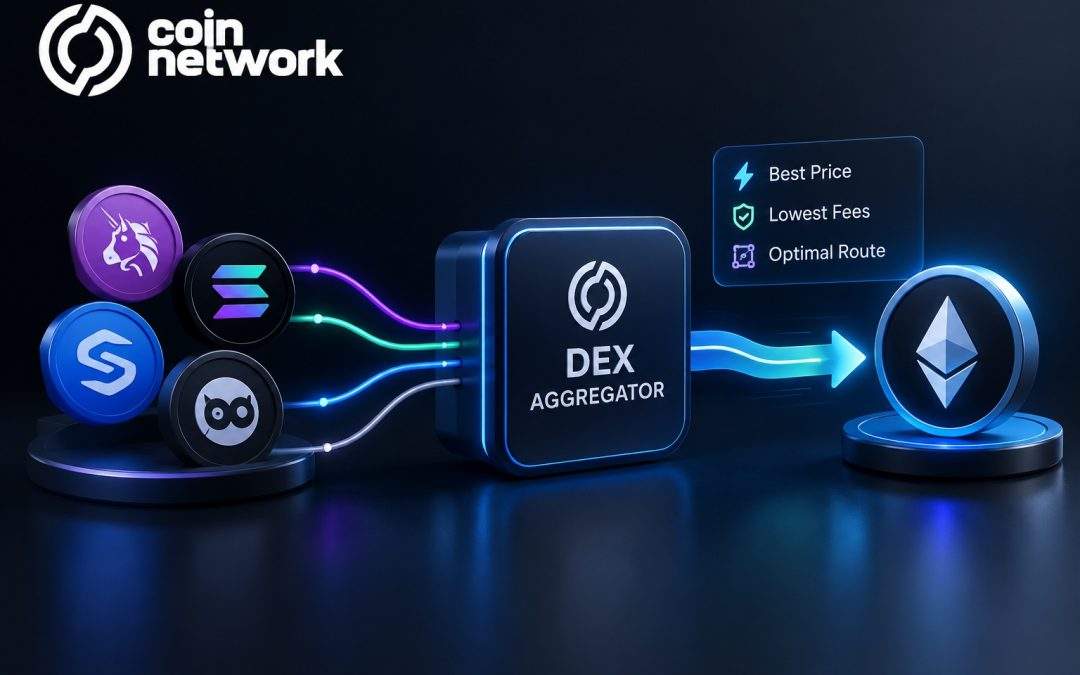
DEX Aggregators are crypto trading services that search across multiple decentralized exchanges and liquidity sources to determine a potentially better route for a token swap.
Instead of asking a trader to compare Uniswap, Curve, SushiSwap, Balancer, and other liquidity venues manually, an aggregator can evaluate available routes and present a single trade option.
Ethereum.org describes 1inch as an exchange aggregator that scans decentralized exchanges to find competitive prices, while its DeFi overview also lists aggregators such as CoW Swap that combine liquidity and routing strategies.Ethereum’s DeFi ecosystem overview provides broader context.
The main idea is simple:
More liquidity sources can give a routing system more options to compare.
However, the route with the highest quoted output is not always the route with the lowest total economic cost. Gas, price impact, fees, slippage, execution risk, and MEV can all matter.
How DEX Aggregators Work
A typical DEX aggregator performs several steps after a user enters a trade.
Suppose a trader wants to swap 10 ETH for USDC.
The aggregator can examine liquidity from multiple markets and estimate how much USDC each route could produce.
It might find:
Direct ETH → USDC on one DEX
ETH → USDT → USDC through two pools
ETH → WETH → USDC through another route
A split trade using several DEXs
A route combining AMM liquidity with professional market-maker liquidity
The routing engine then compares the expected outcome.
The user usually sees one quote even though the transaction may involve multiple liquidity sources.
The exact routing methods differ by provider, but the objective is generally to optimize execution rather than simply choose the exchange with the highest displayed token price.
DEX Aggregators and Liquidity Fragmentation
DEX liquidity is fragmented across many protocols and chains.
A token pair may have liquidity on multiple automated market makers, concentrated-liquidity pools, order-based systems, and professional market-maker networks.
This fragmentation creates both a challenge and an opportunity.
A trader using one DEX may see only the liquidity available on that platform.
An aggregator can compare several venues.
For example,1inch explains its aggregation model as a system that searches multiple DEXs and can split a trade among different liquidity sources.
The benefit can become more noticeable for larger trades because the trader is less dependent on a single pool.
DEX Aggregators and Smart Order Routing
Smart order routing is the main technology behind modern DEX aggregation.
The router can evaluate multiple paths instead of simply selecting the cheapest-looking pool.
Imagine these simplified options:
Route A: ETH → USDC = $30,000
Route B: ETH → USDT → USDC = $30,040
Route C: 60% through DEX A + 40% through DEX B = $30,090
A smart router may choose Route C because the combined result is better under the current liquidity conditions.
The calculation can include:
Expected output
Pool depth
Price impact
Trading fees
Gas costs
Route complexity
Available liquidity
Quote freshness
This is why the term “best route” should generally mean the best estimated execution result, not simply the highest quoted spot price.
DEX Aggregators and Split Trades
One important feature is the ability to split a transaction.
A large swap can move the price in one pool if that pool does not have enough liquidity.
Instead of sending the full transaction through one source, an aggregator can divide the order.
For example:
40% through DEX A
35% through DEX B
25% through DEX C
This can reduce the price impact associated with using one pool.
1inch’s routing documentation specifically describes transaction splitting as a way to spread larger trades across multiple liquidity sources.
However, splitting does not always improve the final result. Additional contract calls can increase gas consumption, and the optimal route depends on the size and structure of the trade.
DEX Aggregators and Multi-Hop Routes
Sometimes the best route is not a direct swap.
A token pair may have limited direct liquidity but deep liquidity through an intermediate asset.
For example:
TOKEN A → USDC → TOKEN B
or:
TOKEN A → WETH → TOKEN B
This is known as a multi-hop route.
Intermediate tokens can act as bridges between fragmented liquidity pools.
Uniswap’s technical walkthrough explains how swap paths can contain multiple exchanges, with routers moving through the specified sequence of pairs.
Aggregators can evaluate these paths alongside direct routes.
The trade-off is that more hops can mean more contract interactions, more gas, and potentially more execution complexity.
DEX Aggregators and Gas Costs
A route with the best token output is not necessarily the cheapest trade.
Suppose:
Route A returns $10,000 and costs $5 in gas.
Route B returns $10,015 but costs $25 in gas.
The second route has a higher gross output but may produce a worse net result after transaction costs.
Gas therefore needs to be included in route optimization.
This becomes especially important on Ethereum when network demand increases.
Ethereum’sDEX design guidance recommends displaying important trade information such as price impact, slippage, expected output, minimum received, gas cost, and other fees.
For traders, this means a good aggregator quote should be evaluated using net execution value, not just the headline output number.
DEX Aggregators, Slippage, and Price Impact
Slippage and price impact are related but different.
Price impact describes the effect that the trade itself has on the market price because of available liquidity.
Slippage is the difference between the expected execution and the amount ultimately received, including movements between quoting and execution.
An aggregator can reduce price impact by finding deeper liquidity or splitting a trade, but it cannot eliminate market movement.
A quote is also not guaranteed forever.
A fast-moving market can change before the transaction reaches the chain.
That is why users should review:
Expected output
Minimum received
Price impact
Slippage tolerance
Gas estimate
Quote expiry
DEX Aggregators and RFQ Liquidity
Modern aggregators do not always rely exclusively on public AMM pools.
Some also use RFQ, or Request for Quote, liquidity from professional market makers.
0x’s June 2026 documentation says its Swap API aggregates liquidity across 150+ DEXs and supports 20+ EVM-compatible chains. It also describes routing across AMMs and professional market makers.0x’s 2026 API overview provides the current details.
Its RFQ documentation states that for selected major trading pairs, RFQ liquidity produced a better price than AMMs around 52% of the time in its measured sample. The document also explains that 0x can combine RFQ and AMM liquidity in a single route.0x’s RFQ explanation provides the methodology and limitations behind that figure.
This is an important development because aggregation increasingly means comparing different types of liquidity, not merely different DEX pools.
DEX Aggregators and MEV
Maximum extractable value, or MEV, can affect swap execution.
A pending transaction can potentially be observed and reordered by market participants depending on the blockchain and transaction flow.
Some trading systems attempt to reduce exposure through private order flow, batch auctions, intent-based execution, or professional market-maker systems.
For example, Ethereum.org describes CoW Swap as a DEX aggregator that uses frequent batch auctions and peer-to-peer matching to seek liquidity while reducing certain forms of MEV exposure.Ethereum’s CoW Swap overview provides more context.
This means traders should not assume every aggregator uses the same execution model.
DEX Aggregators in 2026
DEX aggregation is now a substantial part of decentralized trading infrastructure.
A current DeFiLlama snapshot for Ethereum shows approximately $258.66 million in DEX-aggregator volume over 24 hours and $16.97 billion over 30 days. The same dashboard lists 1inch at roughly $2.13 billion in 30-day aggregator volume, 0x at about $2.58 billion, and CoW Swap at around $3.15 billion.DeFiLlama’s Ethereum DEX Aggregator dashboard provides the continuously updated figures.
For comparison, DeFiLlama’s Ethereum DEX dashboard currently shows approximately $557.46 million in 24-hour DEX volume and $39.51 billion over 30 days.The Ethereum DEX volume dashboard provides the corresponding ecosystem-wide snapshot.
These figures should be treated as live market data rather than fixed 2026 annual totals. Aggregator volume can also involve overlapping liquidity sources and different reporting methodologies, so simple comparisons between individual dashboards should be made carefully.
DEX Aggregators: What Makes a Route “Best”?
The best route depends on what the trader is optimizing.
A route can be evaluated based on:
Highest Expected Output
Useful when price is the primary concern.
Lowest Total Cost
Combines output, gas, and applicable fees.
Lowest Price Impact
Important for larger or less liquid trades.
Lowest Execution Risk
A simpler route may have fewer moving parts.
MEV Protection
Relevant when transaction ordering could materially affect execution.
Fast Execution
Some systems prioritize execution reliability over a small theoretical improvement in output.
The best aggregator therefore is not necessarily the one that always displays the highest quote. It is the one whose execution model best matches the user’s priorities and the current market.
Limitations of DEX Aggregators
Aggregation does not eliminate trading risks.
An aggregator can still route through:
Low-liquidity pools
Vulnerable protocols
Token contracts with transfer restrictions
Tokens with unusual taxes
Reverting liquidity sources
Complex multi-hop paths
A routing engine also depends on accurate quotes and available liquidity.
Users should inspect the final transaction before signing and verify that the received amount, token address, slippage limit, and contract interaction match their intentions.
For broader crypto-security education, Coin Network’sCryptopedia can be useful alongside itsDeFi coverage.
How to Use DEX Aggregators Safely
Before confirming a swap:
Check the Token
Verify the contract address rather than relying only on the ticker.
Compare the Quote
Look at expected output, price impact, and total fees.
Review the Route
Understand whether the trade is direct, split, or multi-hop.
Check Slippage
A very high slippage tolerance can expose a trade to worse execution.
Review Gas
A complex route may require more gas.
Check Approvals
Confirm which token and spender the approval transaction targets.
Review the Final Transaction
Make sure the destination contracts and output assets match the intended trade.
Coin Network’scrypto wallet security guide provides additional guidance on approvals, suspicious dApps, and transaction review.
Common Mistakes When Using DEX Aggregators
Assuming the Aggregator Guarantees the Best Price
Quotes change rapidly and depend on the available liquidity and gas conditions.
Ignoring Gas Costs
A slightly better gross output can become worse after execution costs.
Using Excessive Slippage
A generous slippage setting may make a trade more tolerant but can also increase execution risk.
Ignoring Price Impact
A route can still produce significant market impact when liquidity is thin.
Assuming Every Route Is Equally Safe
Different routes can interact with different contracts and liquidity sources.
Comparing Only the Headline Token Output
Always consider fees, gas, price impact, and minimum received.
DEX Aggregators: Practical Checklist
Before confirming a crypto swap, check:
Quote: What is the expected output?
Route: Which DEXs or liquidity sources are being used?
Split: Is the trade divided among multiple pools?
Price impact: How much does the order move the market?
Slippage: What is the maximum acceptable execution difference?
Gas: How much will the transaction cost?
Fees: Are there aggregator or protocol fees?
Token: Is the contract address correct?
Approval: Which spender receives token permission?
MEV: Is the execution model exposed to ordering risk?
Minimum received: What is the minimum output after tolerance?
Transaction: Does the final wallet request match the quote?
Conclusion
DEX Aggregators make decentralized trading more efficient by comparing fragmented liquidity and automatically selecting or constructing routes for token swaps.
Instead of relying on a single DEX, traders can access direct routes, multi-hop paths, split trades, and in some cases professional RFQ liquidity.
The current 2026 market data shows that aggregation is already a substantial part of Ethereum’s trading infrastructure, with DeFiLlama currently recording about $258.66 million in 24-hour Ethereum DEX-aggregator volume and approximately $16.97 billion over 30 days.
However, aggregation is not the same as a guarantee of perfect execution.
Gas, price impact, slippage, MEV, liquidity quality, token behavior, and smart-contract risk can all affect the final result.
The most useful approach is to treat a DEX aggregator as a routing and execution tool, then review the proposed transaction before signing.
The key question is:
Does the selected route provide the best overall execution after liquidity, price impact, gas, fees, and execution risk are considered?
FAQs
1. What are DEX Aggregators?
DEX Aggregators are platforms or protocols that compare liquidity across multiple decentralized exchanges and attempt to find an efficient route for a token swap.
2. How do DEX Aggregators find the best route?
They compare available liquidity, prices, fees, gas requirements, and potential paths across different sources.
Some systems can split a trade or use multiple hops when that produces a better estimated result.
3. Are DEX Aggregators better than using one DEX?
They can provide more routing options because they can compare multiple liquidity sources.
However, the best choice depends on the trade, chain, liquidity conditions, gas costs, and execution model.
4. Can DEX Aggregators split a trade?
Yes.
A routing system can divide a single order among multiple liquidity sources when doing so is expected to improve execution.
5. What is smart order routing?
Smart order routing is the process of evaluating multiple possible execution paths and selecting a route based on factors such as output, liquidity, price impact, gas, and fees.
6. What is a multi-hop swap?
A multi-hop swap passes through one or more intermediate assets.
For example, a trade might use Token A → USDC → Token B instead of exchanging Token A directly for Token B.
7. Do DEX Aggregators reduce slippage?
They can reduce price impact by finding deeper liquidity or splitting trades, but they cannot eliminate market movement or guarantee a specific execution price.
8. Do DEX Aggregators charge extra fees?
Some aggregators may charge a routing or service fee, while others monetize through other mechanisms.
Traders should review the quote’s fee information before signing.
9. What is RFQ liquidity in a DEX Aggregator?
RFQ, or Request for Quote, allows professional market makers to provide trade-specific quotes.
Some aggregators compare those quotes with public AMM liquidity and use whichever route offers the stronger execution result.
10. Can DEX Aggregators protect against MEV?
Some execution systems are designed to reduce particular MEV risks, but protection varies by aggregator and transaction method.