























DEX Aggregators: What Are They?
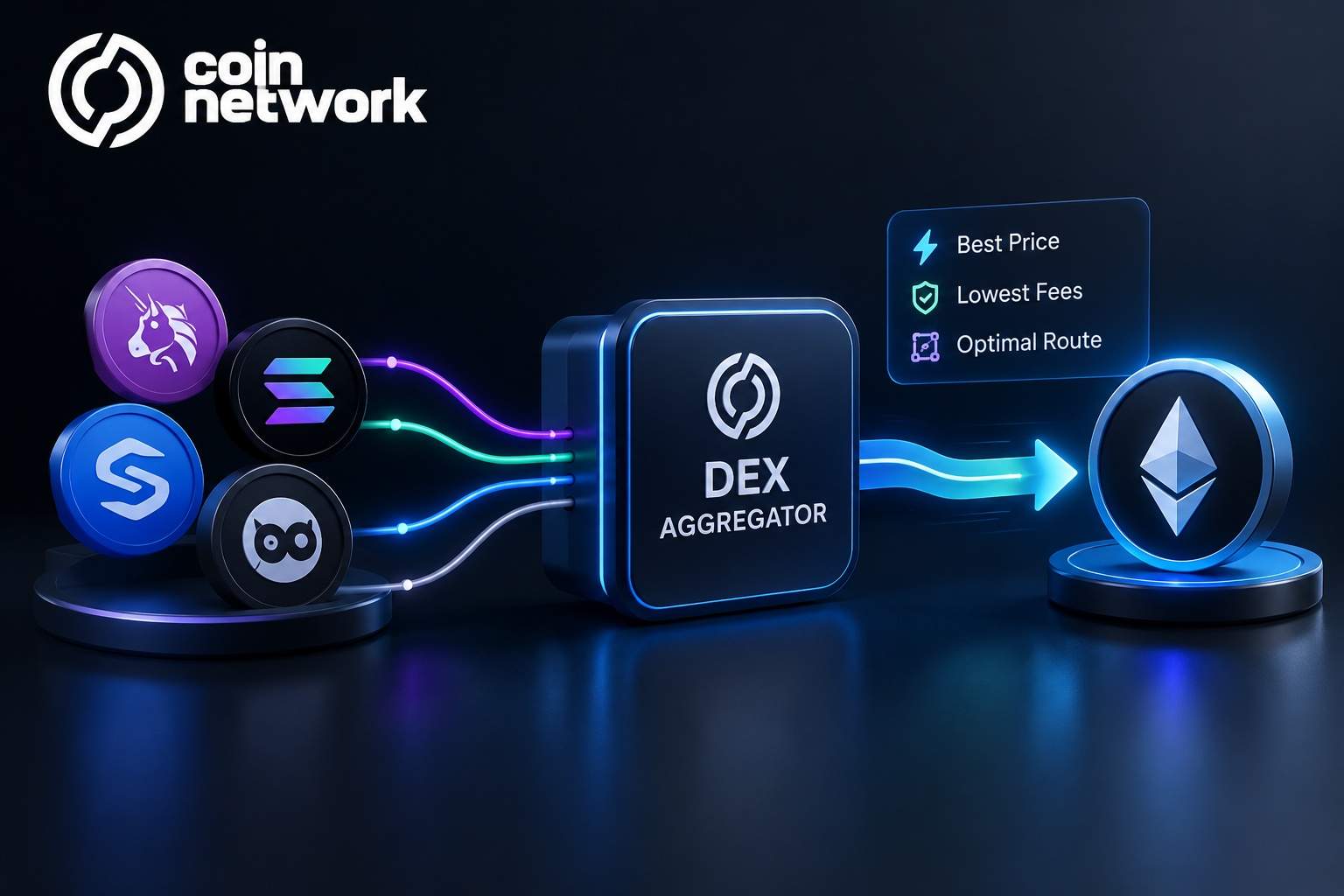
DEX Aggregators are crypto trading services that search across multiple decentralized exchanges and liquidity sources to determine a potentially better route for a token swap.
Instead of asking a trader to compare Uniswap, Curve, SushiSwap, Balancer, and other liquidity venues manually, an aggregator can evaluate available routes and present a single trade option.
Ethereum.org describes 1inch as an exchange aggregator that scans decentralized exchanges to find competitive prices, while its DeFi overview also lists aggregators such as CoW Swap that combine liquidity and routing strategies. Ethereum’s DeFi ecosystem overview provides broader context.
The main idea is simple:
More liquidity sources can give a routing system more options to compare.
However, the route with the highest quoted output is not always the route with the lowest total economic cost. Gas, price impact, fees, slippage, execution risk, and MEV can all matter.
How DEX Aggregators Work
A typical DEX aggregator performs several steps after a user enters a trade.
Suppose a trader wants to swap 10 ETH for USDC.
The aggregator can examine liquidity from multiple markets and estimate how much USDC each route could produce.
It might find:
- Direct ETH → USDC on one DEX
- ETH → USDT → USDC through two pools
- ETH → WETH → USDC through another route
- A split trade using several DEXs
- A route combining AMM liquidity with professional market-maker liquidity
The routing engine then compares the expected outcome.
The user usually sees one quote even though the transaction may involve multiple liquidity sources.
The exact routing methods differ by provider, but the objective is generally to optimize execution rather than simply choose the exchange with the highest displayed token price.
DEX Aggregators and Liquidity Fragmentation
DEX liquidity is fragmented across many protocols and chains.
A token pair may have liquidity on multiple automated market makers, concentrated-liquidity pools, order-based systems, and professional market-maker networks.
This fragmentation creates both a challenge and an opportunity.
A trader using one DEX may see only the liquidity available on that platform.
An aggregator can compare several venues.
For example, 1inch explains its aggregation model as a system that searches multiple DEXs and can split a trade among different liquidity sources.
The benefit can become more noticeable for larger trades because the trader is less dependent on a single pool.
DEX Aggregators and Smart Order Routing
Smart order routing is the main technology behind modern DEX aggregation.
The router can evaluate multiple paths instead of simply selecting the cheapest-looking pool.
Imagine these simplified options:
Route A:
ETH → USDC = $30,000
Route B:
ETH → USDT → USDC = $30,040
Route C:
60% through DEX A + 40% through DEX B = $30,090
A smart router may choose Route C because the combined result is better under the current liquidity conditions.
The calculation can include:
- Expected output
- Pool depth
- Price impact
- Trading fees
- Gas costs
- Route complexity
- Available liquidity
- Quote freshness
This is why the term “best route” should generally mean the best estimated execution result, not simply the highest quoted spot price.
DEX Aggregators and Split Trades
One important feature is the ability to split a transaction.
A large swap can move the price in one pool if that pool does not have enough liquidity.
Instead of sending the full transaction through one source, an aggregator can divide the order.
For example:
- 40% through DEX A
- 35% through DEX B
- 25% through DEX C
This can reduce the price impact associated with using one pool.
1inch’s routing documentation specifically describes transaction splitting as a way to spread larger trades across multiple liquidity sources.
However, splitting does not always improve the final result. Additional contract calls can increase gas consumption, and the optimal route depends on the size and structure of the trade.
DEX Aggregators and Multi-Hop Routes
Sometimes the best route is not a direct swap.
A token pair may have limited direct liquidity but deep liquidity through an intermediate asset.
For example:
TOKEN A → USDC → TOKEN B
or:
TOKEN A → WETH → TOKEN B
This is known as a multi-hop route.
Intermediate tokens can act as bridges between fragmented liquidity pools.
Uniswap’s technical walkthrough explains how swap paths can contain multiple exchanges, with routers moving through the specified sequence of pairs.
Aggregators can evaluate these paths alongside direct routes.
The trade-off is that more hops can mean more contract interactions, more gas, and potentially more execution complexity.
DEX Aggregators and Gas Costs
A route with the best token output is not necessarily the cheapest trade.
Suppose:
- Route A returns $10,000 and costs $5 in gas.
- Route B returns $10,015 but costs $25 in gas.
The second route has a higher gross output but may produce a worse net result after transaction costs.
Gas therefore needs to be included in route optimization.
This becomes especially important on Ethereum when network demand increases.
Ethereum’s DEX design guidance recommends displaying important trade information such as price impact, slippage, expected output, minimum received, gas cost, and other fees.
For traders, this means a good aggregator quote should be evaluated using net execution value, not just the headline output number.
DEX Aggregators, Slippage, and Price Impact
Slippage and price impact are related but different.
Price impact describes the effect that the trade itself has on the market price because of available liquidity.
Slippage is the difference between the expected execution and the amount ultimately received, including movements between quoting and execution.
An aggregator can reduce price impact by finding deeper liquidity or splitting a trade, but it cannot eliminate market movement.
A quote is also not guaranteed forever.
A fast-moving market can change before the transaction reaches the chain.
That is why users should review:
- Expected output
- Minimum received
- Price impact
- Slippage tolerance
- Gas estimate
- Quote expiry
DEX Aggregators and RFQ Liquidity
Modern aggregators do not always rely exclusively on public AMM pools.
Some also use RFQ, or Request for Quote, liquidity from professional market makers.
0x’s June 2026 documentation says its Swap API aggregates liquidity across 150+ DEXs and supports 20+ EVM-compatible chains. It also describes routing across AMMs and professional market makers. 0x’s 2026 API overview provides the current details.
Its RFQ documentation states that for selected major trading pairs, RFQ liquidity produced a better price than AMMs around 52% of the time in its measured sample. The document also explains that 0x can combine RFQ and AMM liquidity in a single route. 0x’s RFQ explanation provides the methodology and limitations behind that figure.
This is an important development because aggregation increasingly means comparing different types of liquidity, not merely different DEX pools.
DEX Aggregators and MEV
Maximum extractable value, or MEV, can affect swap execution.
A pending transaction can potentially be observed and reordered by market participants depending on the blockchain and transaction flow.
Some trading systems attempt to reduce exposure through private order flow, batch auctions, intent-based execution, or professional market-maker systems.
For example, Ethereum.org describes CoW Swap as a DEX aggregator that uses frequent batch auctions and peer-to-peer matching to seek liquidity while reducing certain forms of MEV exposure. Ethereum’s CoW Swap overview provides more context.
This means traders should not assume every aggregator uses the same execution model.
DEX Aggregators in 2026
DEX aggregation is now a substantial part of decentralized trading infrastructure.
A current DeFiLlama snapshot for Ethereum shows approximately $258.66 million in DEX-aggregator volume over 24 hours and $16.97 billion over 30 days. The same dashboard lists 1inch at roughly $2.13 billion in 30-day aggregator volume, 0x at about $2.58 billion, and CoW Swap at around $3.15 billion. DeFiLlama’s Ethereum DEX Aggregator dashboard provides the continuously updated figures.
For comparison, DeFiLlama’s Ethereum DEX dashboard currently shows approximately $557.46 million in 24-hour DEX volume and $39.51 billion over 30 days. The Ethereum DEX volume dashboard provides the corresponding ecosystem-wide snapshot.
These figures should be treated as live market data rather than fixed 2026 annual totals. Aggregator volume can also involve overlapping liquidity sources and different reporting methodologies, so simple comparisons between individual dashboards should be made carefully.
DEX Aggregators: What Makes a Route “Best”?
The best route depends on what the trader is optimizing.
A route can be evaluated based on:
Highest Expected Output
Useful when price is the primary concern.
Lowest Total Cost
Combines output, gas, and applicable fees.
Lowest Price Impact
Important for larger or less liquid trades.
Lowest Execution Risk
A simpler route may have fewer moving parts.
MEV Protection
Relevant when transaction ordering could materially affect execution.
Fast Execution
Some systems prioritize execution reliability over a small theoretical improvement in output.
The best aggregator therefore is not necessarily the one that always displays the highest quote. It is the one whose execution model best matches the user’s priorities and the current market.
Limitations of DEX Aggregators
Aggregation does not eliminate trading risks.
An aggregator can still route through:
- Low-liquidity pools
- Vulnerable protocols
- Token contracts with transfer restrictions
- Tokens with unusual taxes
- Reverting liquidity sources
- Complex multi-hop paths
A routing engine also depends on accurate quotes and available liquidity.
Users should inspect the final transaction before signing and verify that the received amount, token address, slippage limit, and contract interaction match their intentions.
For broader crypto-security education, Coin Network’s Cryptopedia can be useful alongside its DeFi coverage.
How to Use DEX Aggregators Safely
Before confirming a swap:
Check the Token
Verify the contract address rather than relying only on the ticker.
Compare the Quote
Look at expected output, price impact, and total fees.
Review the Route
Understand whether the trade is direct, split, or multi-hop.
Check Slippage
A very high slippage tolerance can expose a trade to worse execution.
Review Gas
A complex route may require more gas.
Check Approvals
Confirm which token and spender the approval transaction targets.
Review the Final Transaction
Make sure the destination contracts and output assets match the intended trade.
Coin Network’s crypto wallet security guide provides additional guidance on approvals, suspicious dApps, and transaction review.
Common Mistakes When Using DEX Aggregators
Assuming the Aggregator Guarantees the Best Price
Quotes change rapidly and depend on the available liquidity and gas conditions.
Ignoring Gas Costs
A slightly better gross output can become worse after execution costs.
Using Excessive Slippage
A generous slippage setting may make a trade more tolerant but can also increase execution risk.
Ignoring Price Impact
A route can still produce significant market impact when liquidity is thin.
Assuming Every Route Is Equally Safe
Different routes can interact with different contracts and liquidity sources.
Comparing Only the Headline Token Output
Always consider fees, gas, price impact, and minimum received.
DEX Aggregators: Practical Checklist
Before confirming a crypto swap, check:
- Quote: What is the expected output?
- Route: Which DEXs or liquidity sources are being used?
- Split: Is the trade divided among multiple pools?
- Price impact: How much does the order move the market?
- Slippage: What is the maximum acceptable execution difference?
- Gas: How much will the transaction cost?
- Fees: Are there aggregator or protocol fees?
- Token: Is the contract address correct?
- Approval: Which spender receives token permission?
- MEV: Is the execution model exposed to ordering risk?
- Minimum received: What is the minimum output after tolerance?
- Transaction: Does the final wallet request match the quote?
Conclusion
DEX Aggregators make decentralized trading more efficient by comparing fragmented liquidity and automatically selecting or constructing routes for token swaps.
Instead of relying on a single DEX, traders can access direct routes, multi-hop paths, split trades, and in some cases professional RFQ liquidity.
The current 2026 market data shows that aggregation is already a substantial part of Ethereum’s trading infrastructure, with DeFiLlama currently recording about $258.66 million in 24-hour Ethereum DEX-aggregator volume and approximately $16.97 billion over 30 days.
However, aggregation is not the same as a guarantee of perfect execution.
Gas, price impact, slippage, MEV, liquidity quality, token behavior, and smart-contract risk can all affect the final result.
The most useful approach is to treat a DEX aggregator as a routing and execution tool, then review the proposed transaction before signing.
The key question is:
Does the selected route provide the best overall execution after liquidity, price impact, gas, fees, and execution risk are considered?
FAQs
1. What are DEX Aggregators?
DEX Aggregators are platforms or protocols that compare liquidity across multiple decentralized exchanges and attempt to find an efficient route for a token swap.
2. How do DEX Aggregators find the best route?
They compare available liquidity, prices, fees, gas requirements, and potential paths across different sources.
Some systems can split a trade or use multiple hops when that produces a better estimated result.
3. Are DEX Aggregators better than using one DEX?
They can provide more routing options because they can compare multiple liquidity sources.
However, the best choice depends on the trade, chain, liquidity conditions, gas costs, and execution model.
4. Can DEX Aggregators split a trade?
Yes.
A routing system can divide a single order among multiple liquidity sources when doing so is expected to improve execution.
5. What is smart order routing?
Smart order routing is the process of evaluating multiple possible execution paths and selecting a route based on factors such as output, liquidity, price impact, gas, and fees.
6. What is a multi-hop swap?
A multi-hop swap passes through one or more intermediate assets.
For example, a trade might use Token A → USDC → Token B instead of exchanging Token A directly for Token B.
7. Do DEX Aggregators reduce slippage?
They can reduce price impact by finding deeper liquidity or splitting trades, but they cannot eliminate market movement or guarantee a specific execution price.
8. Do DEX Aggregators charge extra fees?
Some aggregators may charge a routing or service fee, while others monetize through other mechanisms.
Traders should review the quote’s fee information before signing.
9. What is RFQ liquidity in a DEX Aggregator?
RFQ, or Request for Quote, allows professional market makers to provide trade-specific quotes.
Some aggregators compare those quotes with public AMM liquidity and use whichever route offers the stronger execution result.
10. Can DEX Aggregators protect against MEV?
Some execution systems are designed to reduce particular MEV risks, but protection varies by aggregator and transaction method.
For example, CoW Swap’s Ethereum overview describes its batch-auction model and MEV-protection approach.
11. Are DEX Aggregators safe for every token?
No.
Aggregation improves routing but does not remove smart-contract, token, liquidity, phishing, or execution risks.
Users should verify the token contract and review the final wallet transaction.
12. Where can I learn more about DEX Aggregators and DeFi trading?
For technical background, see Ethereum’s DeFi ecosystem overview, 1inch’s routing explanation, and 0x’s 2026 Swap API documentation.
For broader market and security research, Coin Network’s DeFi resources, Ethereum coverage, and Cryptopedia provide additional educational material.


