























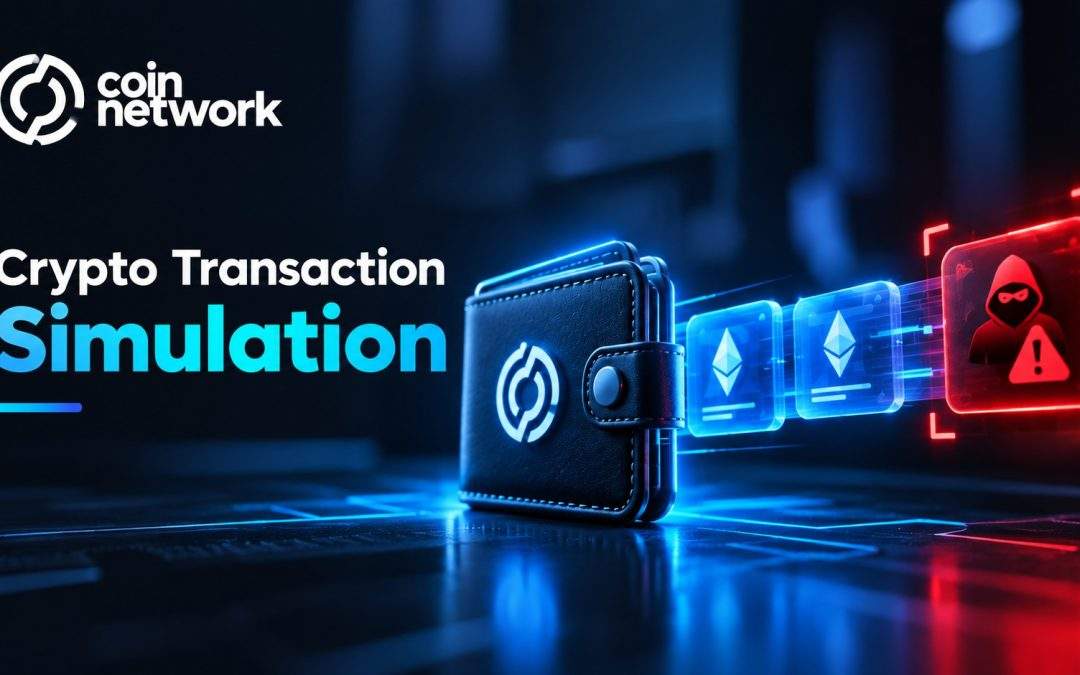
Crypto Transaction Simulation: How Wallets Detect Malicious Transactions
Crypto Transaction Simulation: What Is It?
Crypto Transaction Simulation is a security technique that previews or tests a blockchain transaction before a user signs it. Instead of immediately broadcasting the transaction, a wallet or security service estimates what could happen if the transaction were executed.
A simulation may show potential balance changes, token transfers, NFT movements, approvals, contract interactions, and other state changes.
For example, a user may believe they are claiming an NFT while the transaction actually requests permission for a contract to spend tokens. A transaction preview can provide additional context before the user confirms the request.
MetaMask describes a transaction simulation as a test run that estimates balance changes and shows users what assets may move as a result. Its documentation also explains that standard off-chain simulations can differ from actual on-chain execution in some circumstances. MetaMask’s transaction simulation guide provides the technical details.
This makes simulation a useful security layer, but it should be combined with careful transaction review.
Why Crypto Transaction Simulation Matters
Crypto transactions can be difficult to interpret because smart-contract calls may contain technical instructions that are not obvious from a website interface.
A simulation can help answer practical questions:
- Which tokens could leave my wallet?
- Will I receive an asset?
- Am I granting an approval?
- Is an unexpected contract being called?
- Could the transaction significantly change my wallet balance?
- Does the expected result match what I intended?
This is particularly useful when interacting with decentralized applications, token claims, NFT platforms, DeFi protocols, and unfamiliar websites.
Coin Network’s Crypto Wallet Security in 2026 guide also covers reviewing transaction details, permissions, approvals, and suspicious signing requests before confirming blockchain activity.
How Crypto Transaction Simulation Works
The exact implementation depends on the wallet, blockchain, and security provider.
A transaction normally contains information such as:
- Sender address
- Recipient or contract address
- Network
- Gas parameters
- Transaction value
- Contract calldata
A simulation executes or models the transaction in a controlled environment to estimate the resulting state changes.
The wallet can then present those expected changes before signing.
For an ERC-20 interaction, the preview might show that 500 USDC will leave the wallet. For an NFT transaction, it may show one NFT leaving and another asset arriving.
Security providers can also combine simulation with threat intelligence, contract analysis, address reputation, and phishing detection.
MetaMask explains that its security alerts use on-chain analysis, ecosystem intelligence, and security partners including Blockaid. MetaMask’s security-alert documentation describes how these signals are used.
Crypto Transaction Simulation and Wallet Drainers
Wallet drainers are malicious systems or applications designed to trick users into signing transactions or approvals that may result in asset loss.
Common delivery methods include:
- Fake airdrops
- Counterfeit minting pages
- Fake support websites
- Phishing applications
- Malicious token claims
- Impersonation websites
- Fake investment platforms
A simulation can expose an unexpected result before the user signs.
For example, a website may claim that a user is receiving an NFT while the simulated outcome shows valuable tokens leaving the wallet.
That mismatch is an important warning sign.
However, simulation does not guarantee that every malicious transaction will be detected. MetaMask’s security-alert guidance explicitly states that its security systems are designed to help users identify risks but cannot guarantee detection of every threat.
Crypto Transaction Simulation and Token Approvals
Token approvals deserve particular attention because an approval can create future spending permission rather than immediately transferring an asset.
A user should distinguish between:
A token transfer
and
A permission that allows another contract to spend tokens later.
That distinction matters because a transaction can appear inexpensive or routine while creating a potentially important authorization.
Simulation can help reveal expected permission changes, but users should still review the approval amount and destination contract.
Coin Network’s wallet security guide provides additional guidance on reviewing token permissions and avoiding unnecessary approvals.
For broader approval-phishing research, Chainalysis’ 2026 analysis of approval phishing explains how deceptive signing requests can be used to drain wallets.
Crypto Transaction Simulation and Balance Changes
One of the most useful features of simulation is balance-change analysis.
A preview may conceptually show:
Before
- 1.0 ETH
- 2,000 USDC
- 3 NFTs
Expected after transaction
- 0.98 ETH
- 1,500 USDC
- 2 NFTs
The exact interface varies between wallets and networks.
A significant warning can arise when the simulated result does not match the user’s intention.
For example, if a user expects to receive an NFT but the transaction preview indicates that several valuable tokens will leave the wallet, the user should stop and investigate rather than sign immediately.
Crypto Transaction Simulation and Malicious Smart Contracts
Simulation can also help users understand interactions with unfamiliar smart contracts.
Depending on the transaction, a malicious contract may attempt to:
- Transfer tokens
- Change permissions
- Move NFTs
- Burn assets
- Call additional contracts
- Execute multiple internal operations
A simulator can trace or estimate these changes and present them in a more understandable format.
Blockaid describes its transaction-security technology as providing transaction previews that show the expected on-chain impact before signing, and its current platform says it protects more than 180 million Web3 transactions every month. Blockaid’s transaction-security platform provides the current product information.
This demonstrates how simulation has become part of broader wallet-security infrastructure.
Crypto Transaction Simulation and Red-Pill Attacks
A standard simulation can have limitations if a contract behaves differently during simulation than it does during actual execution.
MetaMask describes sophisticated attacks of this type as red-pill attacks.
In simplified terms, a malicious contract could attempt to appear harmless under simulated conditions while producing a different result during real execution.
MetaMask’s documentation explains that enforced on-chain simulations can address this problem by checking that actual execution matches the simulation. When the execution does not match the expected result, the transaction can revert. MetaMask’s enforced-simulation documentation explains the distinction.
The practical difference is:
A standard simulation predicts an outcome.
An enforced simulation can add a mechanism that requires actual execution to match the predicted outcome.
Support varies by wallet, smart-account implementation, transaction type, and network.
Crypto Transaction Simulation in 2026
The need for transaction-level security remains significant in 2026.
Chainalysis reported that it estimated $17 billion was stolen through cryptocurrency scams and fraud in 2025. Its 2026 report also found that impersonation scams grew by approximately 1,400% year over year, while the average scam payment rose from $782 in 2024 to $2,764 in 2025. These figures are estimates and can increase as additional illicit addresses and transactions are identified. Chainalysis’ 2026 Crypto Crime Report provides the methodology and context.
The FBI’s 2025 Internet Crime Report, released in April 2026, recorded 181,565 cryptocurrency-related complaints from U.S. victims and more than $11.3 billion in reported losses. The FBI’s 2025 Internet Crime Report provides the underlying figures.
Security infrastructure is also operating at large scale. MetaMask reported in June 2026 that its security partner Blockaid had flagged 65.4 million address-poisoning attacks since January 2025. MetaMask’s June 2026 Crypto Security Report explains the detection effort and related wallet protections.
These figures cover different parts of the crypto-security landscape. They should not be interpreted as evidence that every blockchain transaction is dangerous, but they do illustrate why transaction-level risk detection remains relevant.
How Wallets Use Crypto Transaction Simulation
A modern wallet can combine simulation with several other security checks.
Transaction Preview
The wallet estimates expected balance, ownership, and permission changes.
Threat Intelligence
The transaction can be compared with known phishing domains, malicious addresses, scam campaigns, and other security intelligence.
Contract Analysis
The wallet or security provider can inspect contract behavior and transaction calls.
Address Reputation
The destination address may be compared with known or suspicious addresses.
User Warnings
The wallet can display warnings when multiple risk indicators are detected.
MetaMask explains that its security classifications can use information involving phishing domains, contract behavior, impersonation signals, on-chain activity, and ecosystem reporting. MetaMask’s security-alert system provides more detail.
These layers should be viewed as complementary rather than as a single guarantee of safety.
What Crypto Transaction Simulation Can Detect
Simulation can be useful for identifying unexpected outcomes such as:
- Unplanned token transfers
- NFT movements
- Token approvals
- Large balance reductions
- Unexpected contract interactions
- Multi-step asset movements
- Some suspicious permission changes
The effectiveness depends on the wallet, simulation method, blockchain, transaction type, and available security data.
An unknown malicious contract may have little reputation history, while an advanced attack may attempt to obscure its behavior.
A clean simulation therefore should not be treated as proof that a transaction is safe.
What Crypto Transaction Simulation Cannot Guarantee
Simulation does not replace broader security practices.
It may not reliably identify:
- Social-engineering scams
- Fake websites
- Fraudulent project claims
- Poor investment decisions
- Unknown malicious infrastructure
- Every simulation-evasion technique
- Threats involving a compromised device
Users should therefore combine transaction simulation with domain verification, wallet security, permission management, hardware protection, and careful signing.
For broader crypto-security education, Coin Network’s Cryptopedia section provides additional resources.
How to Use Crypto Transaction Simulation Safely
1. Check the Website
Verify that the domain comes from the project’s official channels.
2. Review Wallet Warnings
Do not dismiss a warning simply because the website appears familiar.
3. Read the Simulation
Look carefully at token, NFT, approval, and balance changes.
4. Identify Approvals
Determine whether the transaction creates spending permission for another contract.
5. Compare the Result With Your Intent
Ask whether the transaction preview shows the result you expected.
6. Stop When Something Looks Wrong
Do not sign simply because a website says the transaction is required.
7. Separate Long-Term Holdings
Using a separate wallet for experimental or unfamiliar dApps can reduce the amount of assets exposed to a mistaken interaction.
Common Mistakes With Crypto Transaction Simulation
Treating a Green Result as a Guarantee
A successful simulation indicates an expected execution path under the simulation conditions. It does not establish that the website or project is legitimate.
Ignoring Balance Changes
Users sometimes focus on a warning label without reading which assets are actually expected to move.
Approving Unlimited Spending
A transaction can create significant future permissions even when no asset leaves the wallet immediately.
Trusting a Familiar Brand
Attackers can imitate exchanges, wallets, projects, customer-support pages, and other trusted services.
Skipping Simulation for Small Transactions
A small transaction can still create a dangerous approval or permission.
Assuming All Wallets Simulate the Same Way
Wallets use different security providers, simulation environments, supported networks, and risk models.
Crypto Transaction Simulation: Practical Checklist
Before signing an unfamiliar transaction, check:
- Website: Is the domain authentic?
- Network: Are you using the intended blockchain?
- Contract: Is the destination contract expected?
- Simulation: What changes are predicted?
- Approvals: Are you granting spending permission?
- Assets: Which tokens or NFTs may leave your wallet?
- Gas: Is the expected network fee reasonable?
- Warning: Has the wallet flagged the transaction?
- Intent: Does the result match your intended action?
- Follow-up: Can permissions be reviewed or revoked afterward?
Coin Network’s Crypto Wallet Security in 2026 guide provides additional guidance on approvals, suspicious dApps, wallet protection, and unfamiliar wallet activity.
Conclusion
Crypto Transaction Simulation provides a useful security layer by showing users what a blockchain transaction may do before they sign it.
It can help reveal unexpected balance changes, token transfers, NFT movements, approvals, and other contract interactions that may not be obvious from a dApp’s interface.
However, simulation is not a complete security guarantee.
A stronger approach combines transaction simulation, wallet security alerts, contract and address analysis, domain verification, permission management, and cautious signing behavior.
The 2026 security data from Chainalysis, the FBI, MetaMask, and Blockaid shows that scams and wallet-targeting attacks remain an important part of the crypto-security environment. Transaction-level visibility can therefore be especially useful when interacting with unfamiliar decentralized applications.
For additional research, readers can use Coin Network’s Crypto Wallet Security guide and Cryptopedia resources alongside the security documentation provided by wallet and infrastructure providers.
The key question before signing is:
Does the transaction preview show the outcome I actually intended?
If the answer is unclear, stopping before signing is generally the safer choice.
FAQs
1. What is Crypto Transaction Simulation?
Crypto Transaction Simulation is a method of previewing or testing a blockchain transaction before it is signed and broadcast.
Depending on the wallet, it can estimate balance changes, token transfers, NFT movements, approvals, and other state changes.
2. Can Crypto Transaction Simulation detect malicious transactions?
It can identify some suspicious outcomes and risk signals, but it cannot guarantee detection of every malicious transaction.
MetaMask states that its simulations and security alerts are designed to help users identify potential threats but do not guarantee that every threat will be detected.
3. What can a transaction simulation show?
Depending on the wallet and network, it may show:
- Token transfers
- NFT movements
- Balance changes
- Approvals
- Contract interactions
- Other expected state changes
4. Can a malicious dApp bypass transaction simulation?
Sophisticated attacks can attempt to make simulated behavior differ from real execution.
MetaMask documents these as red-pill attacks and explains that enforced on-chain simulation is designed to help address this mismatch.
5. What is a wallet drainer?
A wallet drainer is malicious software or smart-contract infrastructure designed to obtain digital assets or permissions through deceptive interactions.
Users may be persuaded to sign harmful transactions or approvals.
6. Does a successful simulation mean a transaction is safe?
No.
A successful simulation indicates what the transaction is expected to do under the simulation conditions. It does not establish that the website, contract, project, or financial opportunity is legitimate.
7. Why are token approvals important?
An approval can allow another smart contract to spend a token on behalf of the wallet.
Users should understand the approval amount, token, and destination contract before signing.
8. Can transaction simulation prevent wallet drainers?
It can provide previews and warnings that help users identify potentially harmful transactions.
Some wallet systems also combine simulation with threat intelligence, address reputation, contract analysis, and enforced execution checks.
No single feature eliminates every security risk.
9. How should I react to a malicious transaction warning?
Do not sign the transaction.
Verify the project domain, check the destination address, review the transaction details, and investigate the warning before proceeding.
10. Is Crypto Transaction Simulation available on every blockchain?
No.
Support depends on the wallet, simulation provider, transaction type, and blockchain.
MetaMask currently documents on-chain simulation support across networks including Ethereum, Optimism, BNB, Polygon, Monad, HyperEVM, Sei, Tempo, MegaETH, Robinhood, Arc, Base, Arbitrum, Avalanche, and Linea through its supported implementations.
11. What should I do if I already signed a suspicious transaction?
Stop interacting with the suspicious application, review wallet activity and permissions, and consider moving unaffected assets to a secure wallet where appropriate.
Coin Network’s Crypto Wallet Security guide provides additional information for responding to suspicious wallet activity.
12. Where can I learn more about Crypto Transaction Simulation?
For technical information, see MetaMask’s transaction simulation documentation, its security-alert guide, and Blockaid’s transaction-security documentation.
For broader crypto-security education, Coin Network’s Cryptopedia and Crypto Wallet Security in 2026 provide additional resources.