Binance is a cryptocurrency exchange that is the largest in the world in terms of daily cryptocurrency trading volume. It was founded in 2017. It’s headquarters is in the Cayman Islands. Binance was founded by Changpeng Zhao, a developer who previously built high frequency trading software. Binance was created in China, but it quickly shifted its headquarters before the Chinese government imposed restrictions on cryptocurrency trading.
Binance was investigated for money laundering and tax evasion by the US Department of Justice and the Internal Revenue Service in 2021. In June, the UK's Financial Conduct Authority ordered Binance to cease all regulated business in the country. Binance supplied client information, including names and addresses, with the Russian authorities in 2021.
Binance coin (BNB)
Binance has released two cryptocurrencies that it created: Binance Coin (BNB) and BinanceUSD (BUSD). BNB debuted in July 2017 as an Ethereum currency before transitioning to the Binance Smart Chain (BSC) in September 2020. BSC was eventually combined with the older Binance Chain and re-launched as the BNB chain. BNB Chain employs "Proof of Staked Authority," a hybrid of proof of stake and proof of authority. It has 21 validators who have been approved. Binance Coin was the cryptocurrency with the third greatest market capitalization as of 2021. Binance allows its users to pay fees for BNB exchanges.
BSC works with the Ethereum virtual computer and supports smart contracts (EVM). There have been several concerns about Binance Smart Chain's level of centralization, which has resulted in several network vulnerabilities.
Even if all users begin withdrawals, Binance will not go bankrupt: CZ
Changpeng Zhao, the CEO of Binance, concurred with the rest of the crypto-verse that the exchange had a difficult year. The market was thrown into disarray earlier this month as a result of the massive withdrawal streak. Despite assurances to the community concerning the exchange's reserves and stability, CZ got a similar query yet again.
CZ was questioned during a recent AMA session, "If Binance users withdraw their cash at the same time, would it collapse/go bankrupt? In a nutshell, no," said the CEO of the world's largest bitcoin exchange. "We have more than 100 percent reserves on every currency that we hold on behalf of our users," CZ stated, explaining how the exchange will be fully OK. So feel free to go at any moment."
As previously stated, Binance saw a rise in withdrawals from December 12 to December 14. During this time, the exchange lost a total of $6 billion. The key cause, according to reports, was speculation over the exchange's reserves. However, like CZ, a spokesman for Binance confirmed that user assets are backed by 1:1.
Furthermore, as seen in the accompanying data, Bitcoin outflows rose in November and December 2022. However, if Binance is forced to close, money in the Trust Wallet would be protected, according to CZ.
'Never touch user funds,' CZ advises his colleagues.
The FTX crisis and its subsequent ripple effect created market uncertainty. The cryptocurrency community was eager to see how Binance would handle this situation. CZ emphasized the importance of staying out of such a circumstance in the first place.
Nonetheless, CZ emphasized the need of being "transparent, open, and communicative" when handling billions of dollars in customer cash. He said that there are a few standards in business to never breach those includes never handle user monies. Keep them safe, separate, and run a healthy and sustainable company. Take no shortcuts.
CZ elaborated on the upcoming year, stating that 2022 will be a terrible year. As a result, he hopes that beneficial occurrences occur during 2023. More builders and developers will be needed to create user-friendly systems for ordinary people.
Do Kwon, the South Korean inventor of the bankrupt cryptocurrency Terra, has denied being on the run after Singapore detectives indicated he was not in the city-state as previously assumed. Kwon's whereabouts have been called into doubt following a late-Saturday statement from Singapore police, and his tweets have not revealed where he is. Terraform Labs' failure earlier this year resulted in the loss of around $40 billion in investor funds. Kwon has been accused of fraud by five South Korean investors; he is being probed by a financial crimes unit and the Securities and Exchange Commission in the United States.
On Wednesday, a South Korean court issued an arrest order for Kwon. He tweeted early Sunday, "I am 'not on the run' or anything related," but did not specify where he was. He stated that they are fully cooperating with every agency that has shown a desire to connect, and that they have nothing to conceal.
They are defending themselves in many jurisdictions and hope to prove the truth in the coming months. Previously, the 31-year-old was assumed to be in Singapore, where he gave his first media interview since the crypto operator declared bankruptcy in May. "Do Kwon is now not in Singapore," the Singapore police agency stated in an email late Saturday.
"SPF will help the Korean National Police Agency (KNPA) in accordance with our domestic regulations and international commitments," the short statement added, without going into further detail. According to the Straits Times, Kwon's work visa in Singapore was set to expire on December 7, but his application for renewal may now be jeopardized.
Prosecutors in South Korea have also issued arrest orders for five additional persons associated with the stablecoin TerraUSD and its sibling cryptocurrency Luna. Kwon's Terra/Luna system imploded in May, with the prices of both tokens dropping to near zero and the repercussions affecting the broader crypto market. Its demise resulted in losses of more than $500 billion.
Stablecoins are intended to be reasonably steady in price and are typically tied to a real-world commodity or money. TerraUSD, on the other hand, was algorithmic, utilising programming to keep its price around one US dollar. Many investors lost their life money when the Luna and Terra crashed, and South Korean authorities have launched various criminal investigations into the catastrophe.
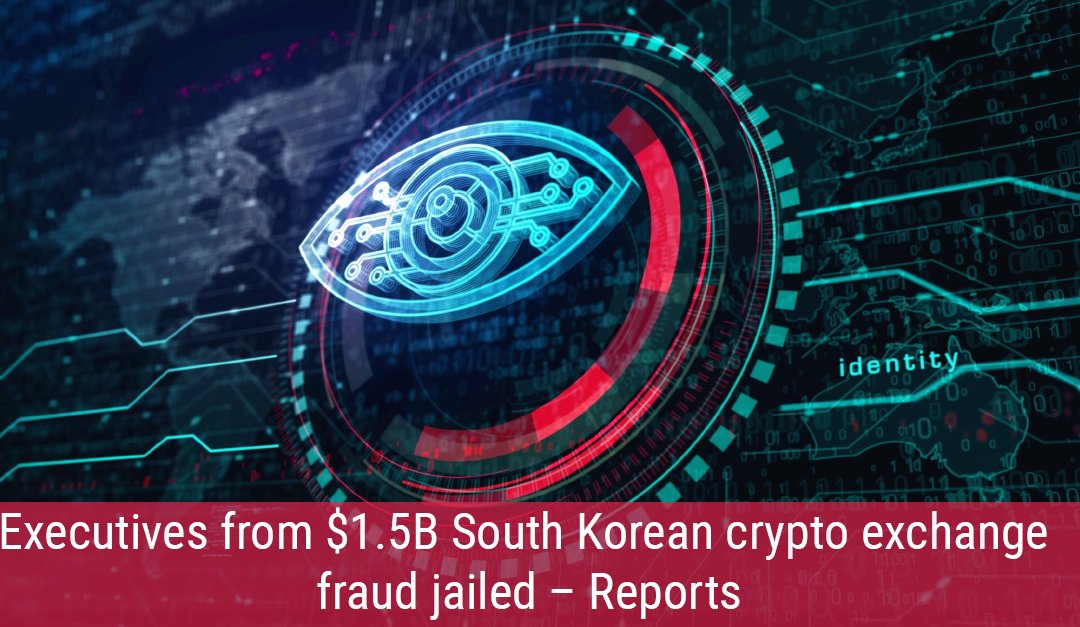
Executives implicated in a $1.5 billion cryptocurrency exchange fraud in South Korea have been imprisoned
The current court decision brings the total number of V Global executives behind bars to seven, after the CEO was previously sentenced to 22 years in jail. Six executives implicated in the $1.5 billion (2 trillion won) South Korean crypto exchange scam V Global were sentenced to up to eight years in jail, although three were not arrested so they could continue to fight charges in court. Between July 2020 and April 2021, V Global attracted over 50,000 investors by promising 300% profits as well as large bonuses for referring new consumers.
According to a translation of December 26 stories from South Korean media sites such as Economist.co.kr, two high-ranking executives, Mr. Yang and Mr. Oh, were sentenced to eight and three years in prison, respectively, for their roles in cheating investors. Another four anonymous executives were sentenced to three years in prison and five years on probation. Three of the six have not yet been jailed because they have claimed innocence and have the right to defend them in court.
"The defendants exclusively trusted the VGlobal management team, avoided accountability, and once the inquiry began, they destroyed evidence and interfered with the investigation," stated the judge from the 12th Criminal Division of the Suwon District Court. The judge, on the other hand, was said to have been kind with the defendants because the real amount of fraud and number of investors affected was smaller than first estimated last year. According to Kyeongin's February reporting, this was due to later evidence indicating that about 10,000 investors had received returns from V Global through payments from multilevel marketing incentives such as customer recruiting bonuses.
Many are alleged to have re-invested their winnings before the portal was shut down. It was claimed in June of last year that the company had paid out $1,000 customer referral incentives to current investors via the infusion of funds from new users in a Ponzi-like method. The recent court action takes the total number of V Global executives behind bars to seven, following the February conviction of the CEO, known as Mr. Lee, for 22 years in prison.
Cryptocurrency is any digital or virtual money that employs encryption to secure transactions. Cryptocurrencies operate without a central issuing or governing organization, instead relying on a decentralized mechanism to record transactions and issue new units.
What exactly is cryptocurrency?
Cryptocurrency is a digital payment system that does not require transaction verification from banks. It is a peer-to-peer payment system that lets anybody send and receive money from anywhere. Cryptocurrency payments exist purely as digital entries to an online database that identify individual transactions, rather than as physical money that can be carried about and exchanged in the real world.
Transactions which involve Bitcoin funds are recorded on a public ledger. Cryptocurrency is stored in digital wallets. The use of encryption to validate transactions is referred to as cryptocurrency. This implies that in order to store and transmit bitcoin data between wallets and public ledgers, a specialized code is necessary.
Encryption's goal is to ensure security and safety. Bitcoin was the first cryptocurrency and remains the most well-known to this day. Much of the interest in cryptocurrencies is speculative, with speculators often driving prices stratospheric.
How does cryptocurrency function?
Cryptocurrencies operate on a distributed public ledger known as the blockchain, which keeps track of all transactions that are updated and retained by currency holders. Mining is a method of constructing bitcoin units that employ computer power to solve complicated mathematical problems. Users may also purchase the currencies from brokers, then store and spend them using cryptographic methods.
If you hold bitcoin, you don't own anything tangible. You have a key that allows you to transmit a record or a unit of measurement from one person to another without the need for a trustworthy third party.
Although Bitcoin has been around since 2009, cryptocurrencies and blockchain technology applications are still in their early stages in terms of financial use, with more utilization expected in the future. Bonds, stocks, and other financial assets may eventually be swapped utilizing the technology. Dmitry Medvedev believes that the US dollar and euro will lose their clout, while cryptocurrencies will grow in favor.
Dmitry Medvedev, a Russian politician who served as President of the country from 2008 to 2012, believes the International Monetary Fund (IMF) and the World Bank will fail in 2023. He stated that such an occurrence may weaken the euro and the dollar while increasing the use of cryptocurrencies. Justin Sun, the founder of Tron, agreed with Medvedev's "insightful statement." He also stated that crypto acceptance in China is progressively increasing and that "the best is yet to come."
Medvedev's Crypto Prediction
Numerous important celebrities and political leaders took advantage of the nearing end of 2022 to reveal their predictions for the coming year. The most recent was Dmitry Medvedev, the former President of Russia and Prime Minister of the world's largest country by landmass.
He believes that the Bretton Woods system (an international monetary accord that standardized currency exchange rates) might fail, resulting in the demise of major financial organizations such as the IMF and the World Bank. As a result, the euro and the dollar, two of the world's top fiat currencies, may lose their supremacy as global reserve currencies, spurring widespread cryptocurrency adoption.
Tron CEO Justin Sun emphasized the politician's argument, saying that cryptocurrency had the capacity to "revolutionize the global reserve currency." In a subsequent tweet, the Chinese said that crypto use is increasing in his nation and that the reopening of borders following the COVID-19 wave, as well as the strength of the economy, are promising signals for the country's monetary system's future.
The List Expands
Medvedev's list of forecasts included some unusual possibilities such as the United Kingdom rejoining the European Union (EU), the emergence of the "Fourth Reich," and a subsequent conflict between France and the "Fourth Reich."
The 57-year-old lawmaker also predicted that all major financial markets and economic activity will transfer from the United States and Europe to Asia.
Furthermore, he believes that a civil war might erupt in the United States, after which Texas and Mexico could become allied states. Elon Musk believes that once the military battle is over, he may win the presidential election in a number of states.
Solana is a highly functional open source project that leverages the permissionless feature of blockchain technology to create decentralised finance (DeFi) solutions. While the project's concept and first development began in 2017, the Solana Foundation, based in Geneva, Switzerland, formally launched Solana in March 2020.
The Solana protocol is designed to make it easier to develop decentralised applications (DApps). It seeks to boost scalability by merging a proof-of-history (PoH) consensus with the underlying proof-of-stake (PoS) consensus of the blockchain. Solana's innovative hybrid consensus process has grabbed the interest of both retail and institutional traders. The Solana Foundation is dedicated to increasing the availability of decentralised money.
What distinguishes Solana?
Anatoly Yakovenko's proof-of-history (PoH) consensus is one of the critical breakthroughs Solana brings to the table. This idea provides for higher protocol scaling, which improves usefulness. Solana is well-known in the cryptocurrency field for the blockchain's lightning-fast processing speeds. The hybrid protocol developed by Solana considerably reduces transaction and smart contract validation times. Because of its lightning-fast processing rates, Solana has also grabbed the interest of institutions. The Solana protocol is intended for both casual and corporate users.
Solana assures customers that they will not be surprised by increasing fees and taxes. The protocol is meant to have minimal transaction costs while ensuring scalability and quick processing. Solana is ranked number 7 in the CoinMarketCap rating as of September 2021, when combined with the lengthy professional skills developers Anatoly Yakovenko and Greg Fitzgerald offer to the project. This followed a spectacular bull run in which the price of Solana increased by approximately 700% from mid-July 2021.
Following the release of the Degenerate Ape NFT collection, SOL reached an all-time high (ATH) of more than $60, and it has been steadily rising since, owing largely to increased developer activity on the Solana ecosystem, increased institutional interest, a growing DeFi ecosystem, and the rise of the Solana NFTs and gaming vertical.
Solana achieved an all-time high of $216 on September 9, 2021.
Solana has garnered a lot of attention for its speed and performance, and it has even been mentioned as a competitor to Ethereum and the dominating smart contract platform. However, the network has experienced repeated outages, undercutting its pricing and ambitions to become the "Visa of cryptocurrency." Furthermore, its ecosystem has been accused of unfair tokenomics that favours venture capitalists. Despite the fact that we are in a bear market, institutions are interested in Solana. It has regularly generated positive flows, making it the institutions' preferred bad market companion. SOL inflows totaled $0.4 million, as previously reported.
The next week, the figure improved much further. SOL reported a $0.7 million positive flow in mid-December. All other crypto asset-related instruments [excluding short bitcoin products], as stated below, saw negative flows. Deribit, the world's largest options exchange, said on Monday that it will no longer provide Solana inverse products. This implies that following the impending December 30, 2022 expiry, no new Solana inverse options or futures will be listed on the market. Deribit's Twitter thread did not elaborate on the cause for the deletion. People in the neighbourhood, on the other hand, ascribed the same to perhaps low demand.
Recovery of Futures OI Notes
Aside from inverse Solana products, the Open Interest for conventional Solana futures contracts has recently increased. The same may be said about fresh money entering the ecosystem. On December 17, the total SOL OI [futures] was $163.66 million. Following the progressive slope, the figure is now north of $217 million. In the same time period, the figure on Deribit increased from $1.89 million to $2.03 million.
New money entering the ecosystem is not necessarily a good indication because traders may be collectively channeling them towards shorting the asset. That appears to be the case for Solana this time. The financing rate was somewhat negative on all major exchanges. The same stated that short traders currently have the upper hand since they are ready to support long traders. As a result, the aggregate trader mood is somewhat pessimistic. SOL has lost 2% on a daily basis and 7.5% on a weekly basis. The market-cap asset valued $4.1 billion was trading at $11.31 at press time.
For the greater part of 2022, stablecoins have been a source of contention. However, Japan has taken a position that may influence the course of this story. For crypto investors residing in Japan, Japanese officials are evaluating potentially substantial limits on the use of stablecoins such as Tether USDT and USD Coin USDC.
Japan will simplify stablecoin operations in 2023.
According to the Nikkei, a Japanese news source, in 2023, the Financial Services Agency (FSA) will lift the restriction on the domestic circulation of foreign-issued stablecoins. If the limitation on foreign-issued stablecoins is abolished, the body in charge of stablecoins in the nation becomes the distributor by default. To protect the tokens' value, distributors will handle them rather than the offshore issuers, according to the newspaper.
The country's new stablecoin law would allow local exchanges to support stablecoin trade in return for asset preservation via deposits and a limit remittance amount. According to the paper, if the usage of stablecoins grows, international remittances might become speedier and less expensive.
In 2023, Japan will eliminate its restriction on foreign-issued stablecoins.
The guidance requires that issuers of stablecoins established inside the region must prepare guaranteed value-added assets and that issuers are confined to banks, registered transfer agents, trust organisations, and so on.
After December 26, the Financial Services Authority will start polling on the guidelines. According to the FSA, authorising stablecoin distribution in the country will demand new anti-money laundering rules. As previously reported, the country's parliament passed legislation preventing non-banking companies from issuing stablecoins beginning in June 2022. Because no local exchanges currently provide trading in stablecoins like USDT or USDC, the new action will have a significant impact on the trading services accessible in the country.
According to official statistics, none of the 31 Japanese exchanges registered with the FSA, including BitFlyer and Coincheck, handled stablecoin trading as of November 30, 2022. Meanwhile, the maximum amount of remittances for such stablecoins is suggested to be 1 million yen, or $7,500 per transaction.
However, it is unclear which stablecoins will return to the Japanese market. One of the stablecoins to join the market might be the USDC created by the American corporation Circle. Tether (USDT), the largest stablecoin, might be another participant.
The current crypto ecosystem in Japan
Recently, Japanese authorities have started creating crypto-related rules. On December 15, Japan's ruling Liberal Democratic Party's tax committee approved a plan to exclude crypto firms from paying taxes on paper gains issued tokens. Local authorities had already warned against the usage of algorithmic stablecoins such as TerraUSD (UST).
The Web3 project team proposed eliminating the tax on paper gains in an intermediate policy proposal. It also included legislative recommendations for decentralised autonomous organisations (DAO) of the LLC variety, as well as support for the issuance of yen-based permissionless stablecoins, governance improvements are being implemented at the Japan Virtual Currency Exchange Association, which is in charge of token screening and auditing requirements for crypto firms. Furthermore, the Digital Agency of Japan said in November that it will establish its own decentralised autonomous organisation (DAO) before obtaining its legal standing.
Furthermore, the Japanese Ministry of Economy has set up a web3 policy agency. Meanwhile, Binance has devised a strategy to re-enter the Japanese market. This follows a year of withdrawal from the market in response to warnings from domestic regulators. The top exchange by volume may purchase the Japanese cryptocurrency exchange Sakura Exchange Bitcoin in an effort to re-enter the market.
Meanwhile, Square Enix and the crypto-heavyweight SBI announced a new collaboration. The Tokyo Stock Exchange-listed gaming firm and SBI agreed to a crypto gaming merger and acquisition deal. In addition to stablecoin legislation, officials are encouraging long-term collaboration with the country's cryptocurrency miners. The partnership between Tokyo Electric Support (TEPCO) and equipment manufacturer TRIPLE-1 will use excess grid electricity to support bitcoin mining.