



















Layer 2 Sequencer Risks: What Happens During Sequencer Downtime
Layer 2 Sequencer Risks: What Is a Sequencer?
Layer 2 Sequencer Risks begin with the role that sequencers play in many Ethereum rollups.
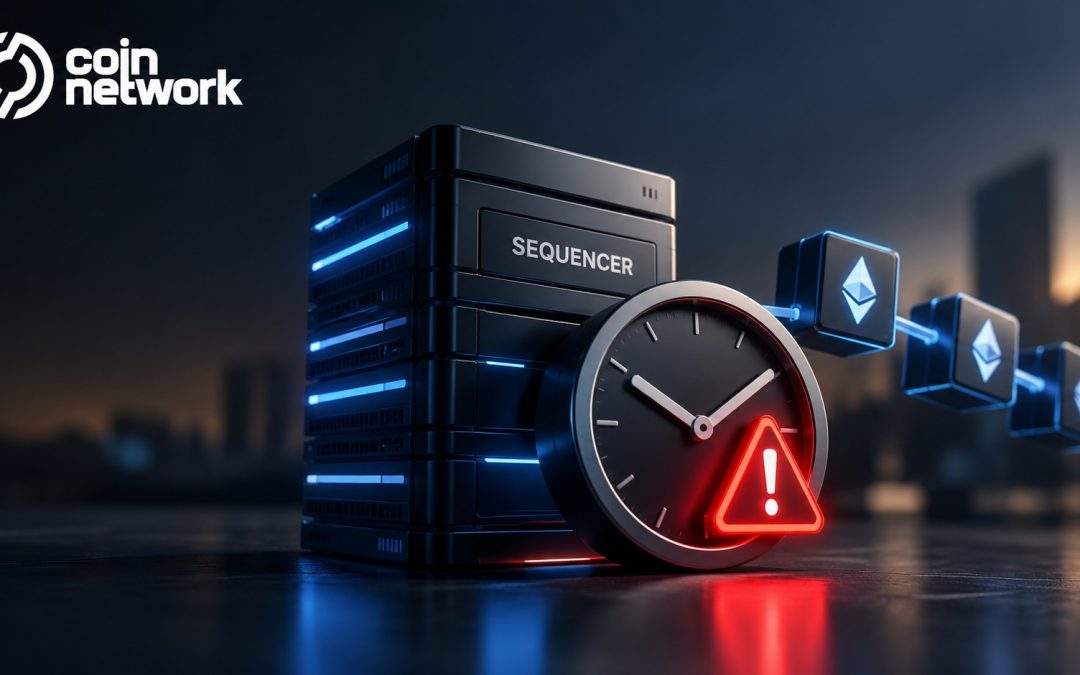
A sequencer is a component responsible for receiving Layer 2 transactions, ordering them, and helping produce L2 blocks. In several major rollups, a centralized or relatively small sequencer set currently handles this work.
Arbitrum’s documentation explains that its sequencer is a specially designated full node with authority over transaction ordering. This allows users to receive transaction results quickly without waiting for Ethereum block production. The same documentation explains that non-sequencer transactions can enter a delayed queue on Ethereum when the normal sequencer path is unavailable. Arbitrum’s explanation of the sequencer provides the technical background.
This design improves the user experience, but it also creates an important operational dependency.
If the sequencer stops producing blocks, normal transaction processing can be interrupted even when Ethereum itself continues operating normally.
Why Layer 2 Sequencer Risks Matter
A sequencer can affect several parts of an L2 user experience.
During normal operation, users send transactions to the rollup’s sequencer, which orders and processes them quickly.
During a failure, users may experience:
- Pending transactions
- Delayed confirmations
- Failed RPC requests
- Stale application interfaces
- Difficulty executing swaps
- Delayed withdrawals
- Temporary inability to interact normally with dApps
The exact impact depends on the rollup’s architecture and the fallback mechanisms available.
This is why sequencer availability is treated separately from the underlying security of Ethereum. A rollup may retain a strong settlement relationship with Ethereum while still having an operational dependency on its sequencer.
L2BEAT currently tracks 22 rollups and reports about $34.84 billion in total value secured across rollups. Its current risk framework separately evaluates sequencer failure, showing why sequencer availability is treated as a distinct architectural consideration. L2BEAT’s rollup overview provides the current ecosystem data and risk classifications.
Layer 2 Sequencer Risks During a Downtime
A sequencer outage does not necessarily mean that user funds are immediately lost.
The first and most common effect is usually a liveness problem.
The L2 may stop producing new blocks or stop accepting transactions through its normal RPC endpoint.
Applications may continue displaying the previous state, making balances or positions appear unchanged even though Ethereum itself remains operational.
This distinction is important.
A sequencer outage can affect the ability to act without necessarily compromising the correctness of previously finalized state.
Some rollups also maintain an L1 escape route that allows users to submit transactions without relying on the sequencer. The design and delay differ between networks.
A Real 2026 Example: Base Sequencer Block Production Outage
Base provides a useful recent example of why Layer 2 Sequencer Risks are an operational issue rather than merely a theoretical concern.
According to Base’s June 2026 postmortem, Base experienced two block-production outages on June 25 and June 26, 2026.
The first outage lasted 116 minutes, while the second lasted 20 minutes.
Base said the incidents were caused by a bug in sequencer block-building logic involving stale journal state after a transaction validation failure. The resulting invalid state transition caused the chain to halt.
During the incidents:
- New L2 blocks stopped being produced.
- Transactions waiting in the mempool were not included on-chain.
- The transaction pool eventually became too large to store all pending transactions.
- Some eth_sendRawTransaction requests returned errors.
Base reported that funds were safe and chain integrity was not compromised. The issue was mitigated by patching the sequencer logic. Base’s June 2026 incident postmortem provides the detailed timeline and root-cause analysis.
This example demonstrates an important distinction: sequencer downtime can disrupt transactions and application functionality without necessarily resulting in a loss of funds.
What Happens to Pending Transactions?
When a sequencer is offline, transactions submitted through the normal L2 route may remain pending or fail to enter the chain.
The exact behavior depends on the network.
On Base, for example, the June 2026 outage caused new transactions to remain unconfirmed because block production had stopped.
Other rollups may continue accepting transactions into a queue even when normal sequencing is unavailable.
For users, the practical lesson is that a wallet showing pending does not necessarily mean the transaction has been accepted into an L2 block.
It is useful to check:
- The L2 status page
- Block explorer activity
- Transaction status
- Sequencer health
- Ethereum L1 activity
- Official incident announcements
Layer 2 Sequencer Risks and Transaction Ordering
Sequencers do more than simply process transactions. They also determine transaction order within the permissions of the rollup’s transaction-ordering system.
This introduces another category of Layer 2 Sequencer Risks.
A centralized sequencer may have greater visibility into pending transactions than ordinary users. Depending on its architecture and policies, that can create opportunities for transaction reordering or MEV extraction.
L2BEAT explicitly identifies potential MEV extraction as a risk for systems where an operator can exploit its centralized position to influence transaction ordering.
For example, L2BEAT’s current risk analysis for OP Mainnet notes the possibility of MEV extraction if the operator exploits its centralized position and frontruns user transactions. L2BEAT’s OP Mainnet risk analysis provides the current assessment.
This does not mean every sequencer is actively exploiting users. It means the architectural position can create additional power that researchers should understand.
Sequencer Downtime vs Censorship
Downtime and censorship are related but different.
Downtime
The sequencer is unavailable or unable to produce new blocks.
Censorship
The sequencer is operating but intentionally or systematically refuses to include specific transactions.
A resilient rollup should ideally have mechanisms that allow users to bypass the sequencer if it becomes unavailable or misbehaves.
Arbitrum’s delayed-inbox design is one example. Its documentation explains that users can submit messages through Ethereum’s Delayed Inbox, and after the applicable delay, transactions can be force-included without relying on the sequencer. Arbitrum’s force-inclusion documentation explains this censorship-resistance path.
The current Arbitrum One design uses a maximum delay of approximately 24 hours before a delayed message can be force-included.
This means sequencer failure does not necessarily create an indefinite ability to block users, but it can create a significant delay.
How Rollups Reduce Layer 2 Sequencer Risks
Rollups can use several mechanisms to reduce sequencer dependency.
Forced Inclusion
Users can send transactions through Ethereum to bypass the normal sequencer.
Delayed Queues
Transactions can remain in an L1-managed queue until the sequencer processes them or the force-inclusion threshold is reached.
Multiple Sequencers
A decentralized or shared sequencer arrangement can reduce reliance on one operator.
Self-Sequencing
Some rollup designs allow users or external operators to participate in block production under certain conditions.
Escape Hatches
Smart-contract mechanisms can allow users to recover assets or execute important actions during sequencer failures.
The specific implementation matters more than the label.
A project describing itself as “decentralized” does not automatically mean that sequencing is fully decentralized.
Layer 2 Sequencer Risks and Withdrawals
Withdrawals are particularly important during downtime because users may need to move assets from an L2 back to Ethereum.
A sequencer outage can make the normal user interface unavailable, but well-designed rollups can maintain L1 pathways for important messages.
The exact withdrawal experience depends on the rollup.
Some systems allow forced L2 inclusion through L1. Others may have specific escape mechanisms or emergency procedures.
Users should therefore check a rollup’s documented exit path before assuming that a sequencer outage makes funds inaccessible permanently.
For broader Ethereum scaling research, Coin Network’s Ethereum coverage and DeFi resources can be used alongside individual rollup documentation.
Layer 2 Sequencer Risks and Decentralization
Sequencer decentralization is still an evolving area.
L2BEAT currently classifies Base and Arbitrum One as Stage 1 rollups, while its framework explains that Stage 2 requires stronger decentralization and permissionless fraud-proof or validity-proof mechanisms along with tighter restrictions on emergency intervention and upgrades.
L2BEAT also emphasizes that its stages measure decentralization maturity rather than providing a complete security rating. Its Stages Framework explains the difference.
This distinction matters because a rollup can reduce sequencer-related trust assumptions while still having other technical or governance risks.
Users should therefore avoid interpreting a stage number as a simple “safe” or “unsafe” label.
2026 L2 Scale Shows Why Sequencer Resilience Matters
The scale of the L2 ecosystem makes sequencer reliability increasingly important.
L2BEAT’s current data shows approximately:
- $34.84 billion secured across rollups
- $16.52 billion secured on Base
- $11.51 billion secured on Arbitrum One
- $2.01 billion secured on OP Mainnet
These values change continuously with asset prices and deposits, so they should be treated as current snapshots rather than fixed totals. L2BEAT’s value-secured dashboard provides the live figures.
As more capital and activity move to L2 networks, an outage can have wider implications for traders, DeFi applications, bridges, and market-making systems.
That does not mean a sequencer outage automatically threatens all assets on the network. It means the ability to process transactions efficiently becomes an increasingly important infrastructure requirement.
What Users Should Do During Sequencer Downtime
If an L2 appears to be experiencing an outage:
Check the Official Status
Confirm that the problem is actually network-wide rather than an issue with your RPC provider.
Avoid Repeated Resubmissions
Submitting the same transaction repeatedly can create confusion once sequencing resumes.
Check the Explorer
Determine whether new L2 blocks are being produced.
Review L1 Escape Options
Read the official documentation for forced inclusion, delayed queues, or other fallback mechanisms.
Be Careful With Time-Sensitive Trades
During an outage, applications may display stale prices or stale positions. Executing a trade immediately after recovery can also expose users to a changed market state.
Wait for Official Confirmation
A healthy RPC response alone does not necessarily prove that the network has fully recovered.
Common Misunderstandings About Layer 2 Sequencer Risks
A Sequencer Failure Means Funds Are Lost
Not necessarily. Sequencer failures primarily create liveness and availability issues, although the consequences depend on the rollup’s architecture.
Ethereum Is Down When an L2 Is Down
Not necessarily. An L2 sequencer can fail while Ethereum Mainnet continues to operate normally.
Every L2 Has the Same Backup Mechanism
No. Force-inclusion, delayed queues, self-sequencing, and escape hatches differ between networks.
Decentralized Sequencing Solves Every L2 Risk
No. It can reduce one class of dependency, but rollups still have smart-contract, bridge, proof-system, governance, and data-availability risks.
Stage 2 Means the Rollup Is Completely Safe
L2BEAT explicitly states that its stages measure decentralization maturity and should not be treated as a complete security rating.
Layer 2 Sequencer Risks: Practical Checklist
Before using a major L2, check:
- Sequencer model: Who operates it?
- Status: Is the sequencer currently healthy?
- Fallback: Can users bypass it?
- Force inclusion: What is the waiting period?
- Censorship resistance: Can a transaction eventually be included without sequencer cooperation?
- Withdrawal path: What happens during an outage?
- MEV: What ordering powers does the sequencer have?
- Decentralization: Is sequencing centralized or distributed?
- Emergency controls: Who can intervene?
- Upgradeability: Who can change the rollup contracts?
- Data availability: Where is transaction data published?
- Recovery: What happened during previous incidents?
For additional blockchain explainers, Coin Network’s Cryptopedia resources can complement the individual rollup documentation.
Conclusion
Layer 2 Sequencer Risks are primarily associated with transaction availability, ordering, censorship resistance, and operational dependency.
A sequencer outage can stop new L2 blocks, leave transactions pending, disrupt DeFi applications, and make normal trading difficult even while Ethereum Mainnet continues functioning.
The June 2026 Base outages provide a recent real-world example. Base experienced a 116-minute outage followed by a 20-minute outage, during which L2 block production stopped and new transactions could not be included normally. Base reported that the incidents did not compromise chain integrity or user funds.
The severity of a sequencer failure ultimately depends on the rollup’s fallback architecture.
Systems with delayed queues and forced inclusion can provide users with a route around a failed or censoring sequencer, although those paths may involve significant delays.
As the Ethereum L2 ecosystem secures tens of billions of dollars, sequencer resilience is becoming an increasingly important part of rollup design.
The key questions for users and developers are:
Who controls the sequencer, what happens if it fails, and can users still force important transactions through Ethereum?
FAQs
1. What are Layer 2 Sequencer Risks?
Layer 2 Sequencer Risks are risks created by dependence on a sequencer to order and process L2 transactions.
They can include downtime, transaction delays, censorship, ordering risks, and operational dependency.
2. What happens when an L2 sequencer goes down?
Depending on the rollup, new L2 blocks may stop, transactions can remain pending, RPC requests may fail, and dApps may become difficult or impossible to use normally.
3. Does sequencer downtime mean my funds are lost?
No, not automatically.
A sequencer outage is generally a liveness or availability problem. Whether users can still move or withdraw funds depends on the rollup’s fallback mechanisms.
4. Can users bypass a sequencer?
Some rollups provide a mechanism for doing so.
Arbitrum, for example, uses a Delayed Inbox and supports force inclusion after the applicable delay. Its official documentation explains the process.
5. How long can an Arbitrum transaction wait during sequencer downtime?
For Arbitrum One, the current maximum delay before force inclusion through the delayed path is approximately 24 hours.
The normal sequencer typically processes delayed messages much sooner, but the fallback mechanism exists for prolonged failures or censorship.
6. What happened during the 2026 Base sequencer outage?
Base experienced two block-production outages on June 25 and June 26, 2026.
The first lasted 116 minutes and the second 20 minutes. Base attributed them to a bug in sequencer block-building logic and said chain integrity and user funds were not compromised.
7. Can a sequencer censor transactions?
Potentially.
A centralized sequencer can have the ability to delay or exclude transactions from its normal sequencing path. The effect and available remedies depend on the rollup’s design.
8. Can sequencers extract MEV?
A sequencer’s control over transaction ordering can create opportunities for MEV extraction.
L2BEAT identifies this as a potential risk for some rollup architectures where a centralized operator has significant ordering power.
9. Are Base and Arbitrum fully decentralized sequencers?
Not currently in the strict sense used by L2BEAT’s decentralization framework.
L2BEAT currently classifies both Base and Arbitrum One as Stage 1 rollups, while its Stage 2 framework requires additional decentralization and trust-minimization properties.
10. Does Ethereum continue working during an L2 outage?
Usually, yes.
An L2 sequencer can experience an operational failure while Ethereum Mainnet continues producing blocks normally.
This is one reason L2 architecture includes mechanisms that use Ethereum as the settlement and fallback layer.
11. What should I do during a sequencer outage?
Check the official status page, avoid repeated transaction submissions, inspect the L2 explorer, review official fallback procedures, and be cautious with time-sensitive trades until normal sequencing resumes.
12. Where can I learn more about Layer 2 Sequencer Risks?
For technical information, see the Arbitrum sequencer documentation, Base’s June 2026 outage postmortem, and L2BEAT’s rollup risk overview.
For broader Ethereum research, Coin Network’s Ethereum coverage, DeFi section, and Cryptopedia provide additional resources.