The recent FTX collapse has impacted the entire crypto industry and even US stocks quite badly. Due to the collapse, the prices of even some of the most popular coins i.e. BTC and ETC went down.
What is FTX?
Before getting into FTX collapse, let’s just talk a little bit about it. Founded in 2018 by former Jane Street Capital international exchange-traded funds trader and an MIT graduate “Sam Bankman-Fried”, FTX Exchange is considered one of the leading centralized cryptocurrency exchanges that specialize in derivatives and leveraged products. Derivatives, Leveraged tokens, options & volatility products are the products offered by FTX. It also provided spot markets in more than 300 cryptocurrency trading pairs including BTC/USDT, ETH/USDT, XRP/USDT, and its native token FTT/USDT.
The FTX Collapse:
FTX petitioned for Chapter 11 bankruptcy protection on Nov. 11, 2022, after a quick go-wrong. The organization's valuation plunged from $32 billion to liquidation surprisingly fast, hauling down the CEO Sam Bankman-Fried’s $16 billion total assets to approach zero. FTX's collapse was a huge shock for the volatile crypto market. It all resulted in billions of lost in value and dropped under $1 trillion.
The outcomes of FTX collapse and breakdown will probably affect cryptocurrencies well into the future and really might haul down more extensive business sectors. On Nov. 16, 2022, a legal claim was filed in a Florida government court, charging that Sam Bankman-Fried made a fake cryptocurrency scheme intended to exploit unsophisticated financial backers from the nation over. Different VIPs named in the claim incorporate Steph Curry, Shohei Ohtani, Shaquille O'Neal, Kevin O'Leary, Naomi Osaka, and Larry David, who supposedly assisted Bankman-Fried with the plan.
At the point when the cryptocurrency industry encountered a $2 trillion crash in May, FTX offered monetary lifesavers to a few falling firms. Its fall has undulated through the market: Lenders, for example, BlockFi and Genesis have reported a pause in their operations due to this collapse. The cost of FTT, a local cryptocurrency token for FTX, has gone down to more than 90% since Nov. 8. The cost of Bitcoin is down around 19% this month, and the cost of Ether is down around 24%.
This year for sure was not the best one for the crypto industry. Let’s hope for the best and see what’s waiting for us in the future of crypto.
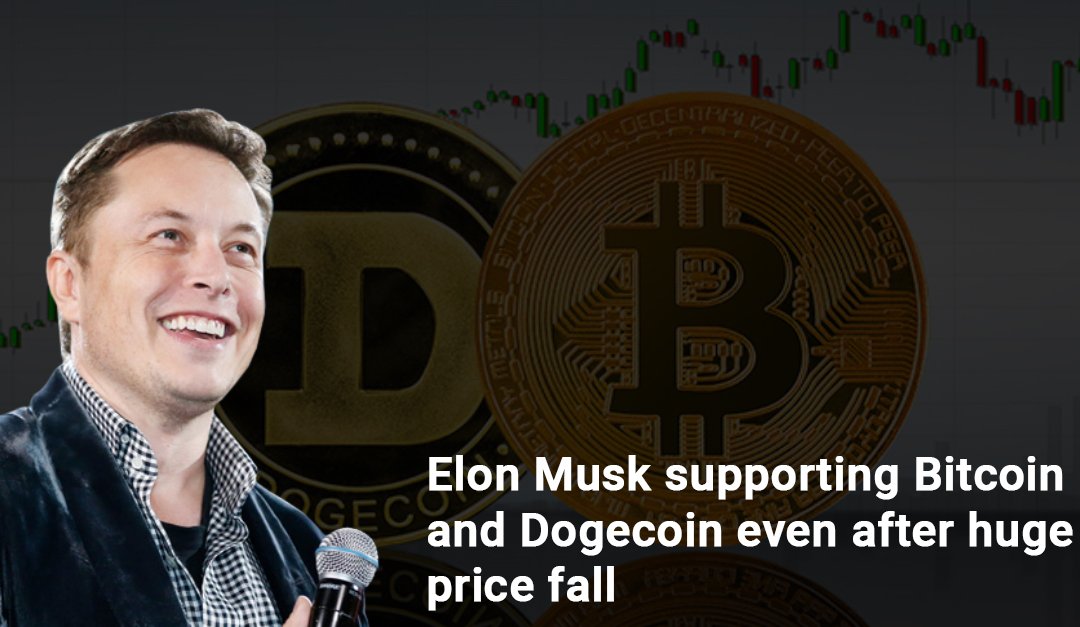
Tesla CEO Elon Musk has made bullish statements about Bitcoin and Dogecoin despite crypto market sell-offs. He predicted the price of Bitcoin will increase further, and stated that there is a future for both these digital currencies i.e. Dogecoin & Bitcoin. Tesla CEO and Twitter chief Elon Musk stated about Bitcoin that “Bitcoin will make it” and “DOGE to the moon.”
Musk is very clear about his support for Dogecoin and its potential as a meme cryptocurrency. He also invested in the Dogecoin economy last year. He plans to buy larger amounts of the cryptocurrency over time and has long been a supporter of the meme crypto. The thing that billionaires like Elon Musk also joined the community has simply added to the Dogecoin craze. Dogecoin is growing, gaining momentum, and being used as a payment method for almost anything. The community has responded by making it the second most popular virtual currency after Bitcoin and the only one to beat Litecoin. Today, it is the tenth biggest digital currency by market cap and it is worth 8.4 billion dollars.
Dogecoin holders have been increasing through July 2022 regardless of the low cost of DOGE. Experts found out that Dogecoin accumulation expanded gigantically in the initial fourteen days of July. DOGE was among the main 10 purchases for BSC whales - with one BSC whale alone purchasing Dogecoin more than $1.25 million worth of.
Also, recently, Tesla Inc. came forward with its third-quarter earnings report. Tesla's Q3 financial reports show that Tesla didn't sell any Bitcoin during the quarter. Its accounting report further reveals that $218 million are in digital resources, unchanged from the second quarter. Tesla purchased $1.5 billion of digital currency in mid-2021 and has not bought any more since. The organization sold around 75% of its BTC possessions in the second quarter of 2022.
Tesla CEO Elon Musk was asked about the future of cryptocurrencies during his appearance at the Space Exploration Technologies Corp. (SpaceX) annual meeting on Saturday (12th November). He stated that investors should keep their cryptocurrencies in a “cold wallet,” not an exchange, and Bitcoin, Dogecoin and Ethereum has a future.
All these moves of the world’s richest man, Elon Musk, clearly show how much support he shows for Bitcoin and Dogecoin. So, if you believe in Elon Musk then it’s high time to invest in these digital currencies to see what benefits are waiting for you in the future.
The recent FTX collapse has affected the entire crypto industry and most of the big coins are going down when it comes to their price. Just recently, we have seen the sudden crash of Bitcoin sinks below $17000 which looks quite alarming to all Bitcoin holders. While on the other hand, for the people who were thinking to buy BTC, it may be a good time for them since they are now less expensive than their value before the collapse.
Cryptocurrency exchange FTX has been struggling to allow withdrawals as the market embarks on a turbulent week. CoinMarketCap data shows that the value of the cryptocurrency market fell 3.8% to $851.6 billion on Monday. Not just the Bitcoin sinks, there are many major coins that are also affected including ETH. Both the crypto Market pioneers Bitcoin and Ethereum were down 6%, as indicated by the data gathered from comics. That slid down the bitcoin's cost to $16,681 from $21,304, a 22% downfall, while ether went straight 24% down to $1,240 from $1,627.
The FTX token was exchanging at $2.65, addressing a loss of almost 90% over the course of the week. Binance coin went to $281.72, carrying its loss of one week to 21%. Fanning the fire, Changpeng Zhao, the President of the opponent Binance exchange, consequently stated on Twitter that he wanted to strip FTX tokens then worth about $580 million.
Changpeng was an early financial backer in FTX and got tokens last year in return for his value in the other exchange. Not just the crypto industry, the FTX collapse has also badly affected US stocks. A US bank i.e. “Silvergate Capital” that lends to the crypto industry also fell 5.1% due to this misfortune.
Despite all these things going on in the crypto industry, investors are waiting for the bull market to make everything go great. We don’t know how much longer it will take to get into the bull market but we are sure that the time is not too far. Till then, you can take advantage of this mishap and get the coins while they're still recovering, because they'll likely be a lot more valuable in the future. Invest now and enjoy your profits in the future. There are risks in every investment, but with a long investment horizon, you can protect yourself against any short-term market movements.
Huobi Global cites adherence to local laws as the justification for leaving New Zealand off of its list of nations where it conducts derivatives trading.
Bitcoin exchange The suspension of derivatives trading in New Zealand has been announced by Huobi Global. According to Huobi's statement, the new prohibitions against derivatives offerings are necessary to comply with local laws.
Users in New Zealand will no longer be able to access derivatives trading services, such as futures and swaps with coin margining, contracts with Tether margining, options, and exchange-traded goods.
On August 23, the new limitations will go into effect. Huobi Global will stop accepting users with New Zealand Know Your Customer-verified locations as well as IP addresses from the country on the same day. Only on and after the restrictions' effective date are users permitted to close out open positions.
The Huobi Group reacted to Cointelegraph in a formal statement, saying that the Group is trying to make an effort to abide by the local laws and regulations in each nation and region where they do business. Compliance is a need before releasing goods and services in any new country, and Huobi shall always adhere to this fundamental tenet.
There are 11 jurisdictions on Huobi's list of prohibited countries, which is always growing. nations like the United States, Canada, and Japan are included in this list. Derivative trading is not available in the United Kingdom, Taiwan, and mainland China.
This comes just after news broke that Huobi co-founder Leon Li wanted to sell a $1 billion+ majority stake in the business. Huobi Global was established in 2013 and manages a daily trading volume of more than $1 billion.
Despite the New Zealand development, the corporation has recently taken steps to broaden its product offers. Early in August, Huobi got approval from Australian authorities—a nation next to New Zealand—to operate as an exchange provider.
Through a subsidiary called HBIT, Huobi obtained a Money Services Business licence from the U.S. Financial Crimes Enforcement Network in July.
These advancements coincide with Huobi's $1 billion investment initiative, which focuses on the growth of Web3 and decentralised finance.
Thai affiliate of Huobi Global closes as Dubai and New Zealand licenses are granted.
Huobi, a cryptocurrency trading platform, has obtained additional licences in New Zealand and the United Arab Emirates as part of its ongoing global expansion. Huobi Group secured the company's first-ever licence at the Dubai International Financial Centre (DIFC) by obtaining the Innovation License under the DIFC.
Lily Zhang, the chief financial officer of Huobi Group, reports that the business has been granted a DIFC licence by Dubai's Virtual Assets Regulatory Authority (DIFC). The DIFC enables Huobi to encourage technology businesses to establish operations in Dubai rather than serving as a trade licence. In order to provide its services in New Zealand, Huobi has also been registered on the Financial Services Provider Register (FSPR). The Virtual Assets Regulatory Authority (VARA) in Dubai will grant Huobi a Virtual Asset MVP License, enabling it to provide a variety of cryptocurrency exchange goods and services.
All exchanges are obliged to register on the platform in order to provide trading services to local users, therefore the FSPR registration is the first step Huobi Group has taken toward growing its bitcoin trading business in New Zealand.
The registration enables it to offer money exchange services and services for the movement of money or value in New Zealand. A spokeswoman for Huobi informed Cointelegraph, that they would want to stress that Huobi Thailand was not a part of Huobi Global, but rather an independent company founded in 2019 as part of Huobi Cloud. The registration enables HBGL New Zealand Limited, a local subsidiary of Huobi, to run a regulated foreign exchange business and provide money or value transfer services in New Zealand.
Decentralized solutions are gradually removing control from Big Tech companies and returning it to developers and users.
Marc Andreessen's seminal 2011 essay, "Why Software Is Eating the World," was well-regarded even at the time it was written and has since shown to be even more prescient than it seemed. Andreessen stated that every firm was now ostensibly a software company, whether the company wanted it or not, at the beginning of a decade in which software would prove invaluable to almost every facet of modern life.
His ideas eventually applied to businesses that either hadn't fully defined their markets or didn't even exist yet but would go on to generate billions in market share, including Uber, Lyft, TikTok/ByteDance, Robinhood, and Coinbase, to name a few. He adapted his argument to many of the market leaders at the time. Software was probably going to be a crucial component in becoming a unicorn in the twenty-first century.
The rise of actual cloud computing and cloud giants, an industry in which Andreessen himself had been a pioneer at a time when many within and outside computers were scoffing at the notion, was the covert force behind this entire transformation of modern economies and life.
But making so many aspects of life so simple came at a high price.
They had stopped scoffing entirely by the second decade of the twenty-first century. Global spending on cloud computing increased by more than quintupling in the 2010s, going from $77 billion to $411 billion. The computer in our pockets relied on it to make everything available at the touch of a button.
As with anything else, the mobile-powered software revolution had trade-offs even if it made life as simple as pressing a button. Software has taken over the globe, making very few, very huge cloud hosting firms the dominant force. Currently, 65% of the market for cloud hosting is dominated by Amazon, Google, and Microsoft.
By using cloud hosting, this established a monopoly of sorts. For instance, hosts can remove services from clouds when using cloud hosting, like Amazon did with the infamous social media service Parler. The Apple App Store likewise prohibited Parler from using it.
Whether or not you concur with a service like Parler doesn't matter when it comes to the bigger issue at hand. The episode proved that, in the post-software world, it just takes two corporations—Amazon and Apple—to totally shut down a service, effectively forcing it out of existence.
What happens if a developer or service violates a less serious Amazon policy or term of service? The internet has been forced into a corner where it can no longer fully function as a marketplace for open ideas and growth, especially if that development is in some way seen as a threat by businesses like Amazon and Microsoft.
Creating a new world is possible with Apple nodes.
Newer blockchain protocols have the potential to "break" data in a world where software and oligopolistic firms have taken over, just as Bitcoin "broke" money and allowed people to think about the exchange of value in new ways. Web3 and the initiatives it will spawn promise to fundamentally alter how information lives and is transmitted via the internet in a transparent and self-sufficient manner. Ecosystems that prioritise decentralisation and community promise to return control to creators and users. This will make it possible to create a common framework that supports best practises and economies of scale and can compete with the biggest centralised internet corporations. Ecosystems that prioritise decentralisation and the community offer to return control to programmers and, by extension, the users of their decentralised applications (DApps) and software.