Interactive Brokers has rolled out Ethereum staking for eligible clients, the Nasdaq-listed brokerage announced on Tuesday, October 13. The service runs through crypto infrastructure provider zerohash and lets qualifying Interactive Brokers LLC customers earn rewards on their ETH holdings directly from the firm's Client Portal.
The launch puts one of the largest U.S. brokerages, which reports more than $903 billion in client assets and over 5 million clients worldwide, into a staking market worth roughly $110 billion. It also deepens a digital asset push that already spans trading in 20 cryptocurrencies, stablecoin funding and futures, as institutional participation in Ethereum staking climbs.
How the Ethereum Staking Service Works
Eligible customers access the product through a Staking Dashboard inside IBKR's Client Portal, where they can submit staking and unstaking requests and monitor pending activity. "At launch, eligible Interactive Brokers LLC clients can stake Ethereum through the Staking Dashboard in IBKR's Client Portal, where they can submit stake or unstake requests and monitor pending activity," the firm said. Availability depends on the client's account affiliation and country of residence.
Zerohash, one of the brokerage's two crypto infrastructure partners alongside Paxos, operates the staking service behind the scenes. Rewards are credited in ETH and added to the staked balance, where they can compound for as long as the position remains staked. The product supports Ethereum only at launch.
The brokerage has not disclosed a specific staking fee or a guaranteed annual yield, and the release did not say what share of rewards zerohash or Interactive Brokers will retain. Zerohash has said platforms set their own customer fees, which are deducted from staking rewards before clients receive their portion. The firm's advertised crypto trading commissions of 0.12% to 0.18% are separate from any staking charges.
Clients also face limits on access to staked holdings. ETH committed to validators cannot be sold or moved right away, and getting it back means going through an unstaking procedure that Ethereum's validator exit queue can slow down. Interactive Brokers has not provided a guaranteed withdrawal deadline, and it cautions that digital assets held via its crypto partners are not under the firm's own custody and fall outside Securities Investor Protection Corp. protection.
Galik Frames Staking as Income Tool
Chief executive Milan Galik presented the product as a way for clients to generate income on assets already in their accounts, drawing a parallel with the firm's Stock Yield Enhancement Program, which pays customers a share of revenue from lending out their fully paid shares. "Similar to how our Stock Yield Enhancement Program allows clients to earn additional income on shares they own, staking gives clients an opportunity to earn rewards on the cryptocurrency they own," Galik said.
"We want clients to earn more from the assets they hold," Galik added. Blockhead noted the comparison is useful for the broker's customer base but that the economics differ: income from lending shares hinges on how much borrowers want a given stock, whereas staking yields are generated by the Ethereum network's issuance and transaction fees and expose holders to protocol risks such as slashing and unbonding delays.
Institutional Share of Staked ETH Climbs
The brokerage enters the market as Ethereum staking sits near record levels. Roughly 43.7 million ETH, or 35.77% of circulating supply, is now locked with validators, per validatorqueue.com figures sourced from the beaconcha.in explorer. With ETH changing hands near $2,500, that staked pile carries a value of about $110 billion.
Growth has continued through a prolonged slide in crypto prices. Lido's first-half report showed staked ETH rose 19% to 43.1 million by June 30 from 36.3 million at the start of January, even as the token lost 47% of its dollar value. Much of that increase came from institutional and custodial staking services, with the institutional segment's share of staked ETH rising to 35.3% from 25.9% over the six months, according to Lido.
Lido's own market share slipped to 21.2% from 23.9% over the period despite higher deposits through its protocol, a shift that illustrates the expanding role of institutional platforms in a market long dominated by crypto-native providers. Interactive Brokers arrives with an existing client base accustomed to trading stocks, bonds, futures and digital assets in one account, positioning it to compete for assets investors might otherwise hold at specialized exchanges or staking providers.
Part of a Broader Crypto Buildout
Staking extends a series of crypto additions the firm has made this year. January brought 24/7 account funding with stablecoins, March allowed clients to move existing crypto holdings onto the platform without selling first, and July saw twelve more tokens listed via zerohash and Paxos plus the ability to send stablecoins to wallets outside the firm. Clients can now trade 20 digital assets, including Bitcoin, Solana, XRP, Chainlink, Aave and Dogecoin, and fund accounts with USDC, RLUSD and PYUSD.
Earlier this year the brokerage also introduced Bitcoin and Ethereum futures through a partnership with Coinbase Derivatives, including nano contracts, and it offers access to Kalshi, CME Group and ForecastEx prediction markets. The regulatory path for U.S. brokers offering staking widened in May 2025, when the SEC's Division of Corporation Finance said staking on a protocol, even when a third party arranges it on a custodial basis, falls outside the offer and sale of securities. The statement is staff guidance rather than a binding Commission regulation, but it cleared away the chief legal barrier that had deterred many U.S. intermediaries from offering the product, Blockhead reported.
Zerohash, the firm powering IBKR's staking product, has on its own pursued a federal banking charter. Records from the OCC show a second trust bank application filed in August for a proposed Zerohash National Trust Bank to be headquartered in Asheville, North Carolina, after the regulator returned an initial filing in July, according to crypto.news.
IBKR Stock Reaction and Analyst Views
IBKR shares slipped following the announcement, trading near $87 and down more than 1% during the session, according to TradingView data cited by EconoTimes and Coingape. The stock has fallen roughly 4% over the past month but remains up more than 32% year to date.
Simply Wall Street described the Ethereum staking feature as additive to client engagement, arguing it folds crypto yield, inexpensive trading and stablecoin funding into a single brokerage workflow that could keep more assets and activity inside the platform. The outlet said the launch on its own does not materially change the primary catalysts or risks, with the rate environment remaining the biggest near-term swing factor for earnings.
Analysts tracked by Simply Wall Street expect quarterly earnings of $0.66 per share on $1.83 billion of revenue, and the site's narrative projects $10.7 billion in revenue and $1.8 billion in earnings by 2029. The most optimistic analysts were already penciling in roughly $11.8 billion of revenue and $1.9 billion of earnings by 2029 before the staking launch, according to the outlet.
Conclusion
Interactive Brokers has added Ethereum staking to a platform that already spans crypto trading, stablecoin funding, futures and prediction markets, with zerohash running the underlying service. Eligible Interactive Brokers LLC clients can stake and unstake through the Client Portal's Staking Dashboard, though fees, reward splits and withdrawal timing remain undisclosed, and staked ETH held through the firm's crypto providers does not qualify for Securities Investor Protection Corp. coverage. The product launches with Ethereum only, and the company has not said when or whether additional assets will follow.
Frequently Asked Questions
When did Interactive Brokers launch Ethereum staking?
Interactive Brokers announced Ethereum staking for eligible clients on Tuesday, October 13. Qualifying Interactive Brokers LLC customers can stake ETH through the Staking Dashboard in the firm's Client Portal, with crypto infrastructure provider zerohash operating the service.
Who provides Interactive Brokers' Ethereum staking service?
Zerohash, one of the brokerage's two crypto infrastructure partners alongside Paxos, provides the staking service. Clients submit staking and unstaking requests and track activity through IBKR's own platform, while rewards are credited as additional staked ETH that can compound.
What fees does Interactive Brokers charge for ETH staking?
The brokerage has not published a specific staking fee or a guaranteed annual yield, and the release did not say what share of rewards it or zerohash retains. Zerohash says platforms set their own fees, deducted from rewards. The broker's 0.12% to 0.18% crypto trading commissions are separate.
How much ETH is currently staked on Ethereum?
About 43.7 million ETH, or 35.77% of circulating supply, is committed to validators, according to validatorqueue.com data from beaconcha.in. With ETH priced near $2,500, that staked total is valued at roughly $110 billion. Lido reported institutional staking's share rose to 35.3% in the first half.
Can staked ETH on Interactive Brokers be withdrawn at any time?
No. Staked ETH cannot be sold or transferred immediately, and getting it back requires an unstaking procedure that Ethereum's validator exit queue can delay. Interactive Brokers has not given a guaranteed withdrawal deadline and warns that crypto held through its providers does not qualify for Securities Investor Protection Corp. coverage.
A long-inactive dormant Ethereum address holding 12,746 ETH has reactivated after sitting motionless for roughly 10.2 years, blockchain tracking service Whale Alert reported. The stash of tokens is valued at approximately $31.7 million, according to Coinfomania.
The transaction marks the first on-chain transfer from the wallet in more than a decade, according to Coinfomania and Crypto Briefing. The sudden motion has attracted attention across the cryptocurrency sector as observers track whether the assets will enter the open market.
Coinfomania noted that the activation of a dormant address carrying significant balances often commands strong attention from market participants who monitor wallet behavior. Whale Alert flagged the initial transaction after logging the sudden movement of the 12,746 ETH balance, according to Crypto Briefing.
Activation Details and Wallet History
Blockchain tracking platform Whale Alert observed the activation of the dormant Ethereum address, which held exactly 12,746 ETH prior to the movement, Crypto Briefing reported. The confirmed portion of the event remains the wallet activation itself.
The assets sat untouched for about 10.2 years before the current transaction, according to Crypto Briefing. Coinfomania reported that the 12,746 ETH stored within the wallet carried an estimated worth of $31.7 million at the time of the reactivation.
Crypto Briefing reported that public records have not established where the coins were transferred or what the wallet owner plans to do next. The early-era wallet joins an expanding roster of historically quiet cryptocurrency addresses coming back into service.
Coinfomania reported that a dormant Ethereum address valued at $31.7 million had resumed activity after more than ten years of inactivity. The outlet noted that the wallet held 12,746 ETH undisturbed before its sudden awakening.
Patterns Across Resurfacing Early Accounts
The movement is not an isolated event among legacy holders, according to Crypto Briefing. Throughout 2025 and 2026, multiple dormant accounts resurfaced on-chain, including separate transactions involving 10,000 ETH, 2,000 ETH, and 40,000 ETH.
On-chain monitoring services including Lookonchain, Arkham Intelligence, Whale Alert, and block explorer Etherscan have consistently tracked transactions from these historical wallets, Crypto Briefing reported. Many of these addresses belong to investors who took part in Ethereum's original initial coin offering.
An initial coin offering functions as a capital-raising mechanism where a project offers tokens directly to the public ahead of or around its network launch, Crypto Briefing noted. Early participant purchase costs were comparatively small, with some accounts acquiring substantial ETH balances for as little as $3,100, generating steep returns at contemporary valuations.
Crypto Briefing noted that the economics underpinning those original early purchases are striking given subsequent network growth. Those early buyers who held through multiple market cycles now command tens of millions of dollars in total value from modest baseline outlays.
Typical Behavior for a Dormant Ethereum Address
Blockchain analytics firms monitoring veteran wallets have noted consistent behavioral patterns, according to Crypto Briefing. Owners who hold a dormant Ethereum address typically initiate activity with a minimal test transaction before transferring larger sums once operational safety is verified.
Historical outcomes following the return of inactive accounts have diverged, Crypto Briefing reported. Some participants route digital assets directly to centralized exchanges, a pattern commonly seen prior to asset sales, while other investors deposit their holdings into staking arrangements.
Staking requires locking tokens to assist in validating and securing the underlying blockchain in exchange for programmatic payouts, Crypto Briefing explained. Data shows several returning accounts preferred yield generation over liquidating positions, demonstrating that certain early buyers prioritize network yield over converting tokens to cash.
Coinfomania explained that Ethereum functions as a decentralized platform supporting smart contracts and decentralized applications. As the network's health and user engagement continue to evolve, transactions originating from ancient wallets draw heightened scrutiny from market participants.
Market Scrutiny and Future Flow Analysis
The reactivation of the dormant Ethereum address holding $31.7 million in assets may bring increased scrutiny to the tactical behavior of major market participants, according to Coinfomania. The publication noted that traders are advised to observe how markets respond to the movement.
Market participants are monitoring whether subsequent transfers create spot selling pressure or signal long-term retention, Coinfomania and Crypto Briefing reported. In previous instances, individual wallet reactivations were processed by the market without triggering severe ETH price volatility, according to Crypto Briefing.
Market analysts emphasize that subsequent transfers will provide clearer direction than the initial wake-up transaction, Crypto Briefing reported. Movements directed toward exchange deposit infrastructure would suggest liquidation intent, whereas transfers to staking contracts point toward continued holding.
Coinfomania reported that trading volumes remain low and Ethereum market dynamics are currently fluctuating with mixed conditions. Market dynamics can shift rapidly during large transactions, sparking speculation regarding whether early whales plan to divest or hold.
The reactivation reported by the Whale Alert tracker could indicate strategic positioning or renewed interest within the ecosystem, Coinfomania reported. Traders remain keen to monitor whether price moves follow as market participants absorb the return of the historical wallet balance.
Conclusion
Blockchain monitoring confirmed that the dormant Ethereum address carrying 12,746 ETH stirred after roughly 10.2 years of inactivity, with the underlying stash valued at $31.7 million. Public records have not disclosed the recipient address or the asset owner's ultimate objective.
Market observers continue to watch on-chain explorers to see whether follow-up transactions transfer the assets into exchange accounts for liquidation or deposit them into network staking contracts.
Frequently Asked Questions
How much cryptocurrency did the dormant Ethereum address hold?
The address contained 12,746 ETH, which was valued at approximately $31.7 million at the time of its activation, according to Coinfomania and Crypto Briefing.
How long was the 12,746 ETH address inactive?
The wallet remained completely untouched on the blockchain for approximately 10.2 years before its first transaction was observed by tracking services, Crypto Briefing reported.
Who initially reported the movement of the 12,746 ETH?
Blockchain tracking platform Whale Alert flagged the initial movement of the 12,746 ETH after monitoring the long-silent address coming online, according to Crypto Briefing.
Where were the 12,746 ETH coins transferred?
Public reporting has not established the destination of the coins or the intention behind the transfer, leaving the wallet activation as the only confirmed detail, according to Crypto Briefing.
Layer 2 Sequencer Risks begin with the role that sequencers play in many Ethereum rollups.
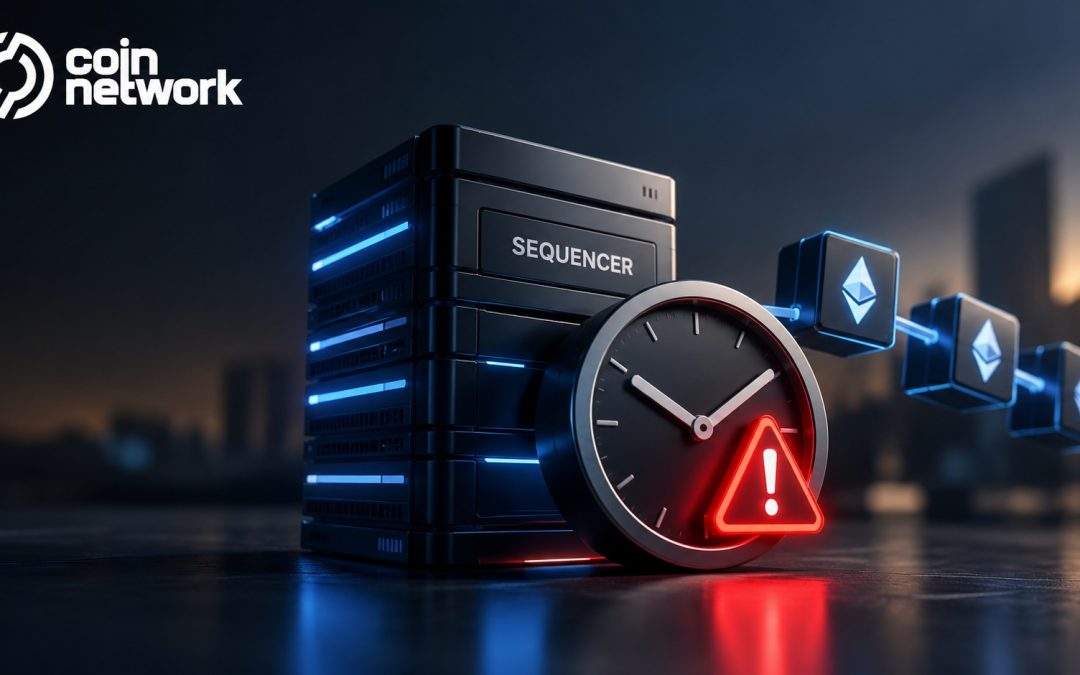
A sequencer is a component responsible for receiving Layer 2 transactions, ordering them, and helping produce L2 blocks. In several major rollups, a centralized or relatively small sequencer set currently handles this work.
Arbitrum’s documentation explains that its sequencer is a specially designated full node with authority over transaction ordering. This allows users to receive transaction results quickly without waiting for Ethereum block production. The same documentation explains that non-sequencer transactions can enter a delayed queue on Ethereum when the normal sequencer path is unavailable.Arbitrum’s explanation of the sequencer provides the technical background.
This design improves the user experience, but it also creates an important operational dependency.
If the sequencer stops producing blocks, normal transaction processing can be interrupted even when Ethereum itself continues operating normally.
Why Layer 2 Sequencer Risks Matter
A sequencer can affect several parts of an L2 user experience.
During normal operation, users send transactions to the rollup’s sequencer, which orders and processes them quickly.
During a failure, users may experience:
Pending transactions
Delayed confirmations
Failed RPC requests
Stale application interfaces
Difficulty executing swaps
Delayed withdrawals
Temporary inability to interact normally with dApps
The exact impact depends on the rollup’s architecture and the fallback mechanisms available.
This is why sequencer availability is treated separately from the underlying security of Ethereum. A rollup may retain a strong settlement relationship with Ethereum while still having an operational dependency on its sequencer.
L2BEAT currently tracks 22 rollups and reports about $34.84 billion in total value secured across rollups. Its current risk framework separately evaluates sequencer failure, showing why sequencer availability is treated as a distinct architectural consideration.L2BEAT’s rollup overview provides the current ecosystem data and risk classifications.
Layer 2 Sequencer Risks During a Downtime
A sequencer outage does not necessarily mean that user funds are immediately lost.
The first and most common effect is usually a liveness problem.
The L2 may stop producing new blocks or stop accepting transactions through its normal RPC endpoint.
Applications may continue displaying the previous state, making balances or positions appear unchanged even though Ethereum itself remains operational.
This distinction is important.
A sequencer outage can affect the ability to act without necessarily compromising the correctness of previously finalized state.
Some rollups also maintain an L1 escape route that allows users to submit transactions without relying on the sequencer. The design and delay differ between networks.
A Real 2026 Example: Base Sequencer Block Production Outage
Base provides a useful recent example of why Layer 2 Sequencer Risks are an operational issue rather than merely a theoretical concern.
According to Base’s June 2026 postmortem, Base experienced two block-production outages on June 25 and June 26, 2026.
The first outage lasted 116 minutes, while the second lasted 20 minutes.
Base said the incidents were caused by a bug in sequencer block-building logic involving stale journal state after a transaction validation failure. The resulting invalid state transition caused the chain to halt.
During the incidents:
New L2 blocks stopped being produced.
Transactions waiting in the mempool were not included on-chain.
The transaction pool eventually became too large to store all pending transactions.
Some eth_sendRawTransaction requests returned errors.
Base reported that funds were safe and chain integrity was not compromised. The issue was mitigated by patching the sequencer logic.Base’s June 2026 incident postmortem provides the detailed timeline and root-cause analysis.
This example demonstrates an important distinction: sequencer downtime can disrupt transactions and application functionality without necessarily resulting in a loss of funds.
What Happens to Pending Transactions?
When a sequencer is offline, transactions submitted through the normal L2 route may remain pending or fail to enter the chain.
The exact behavior depends on the network.
On Base, for example, the June 2026 outage caused new transactions to remain unconfirmed because block production had stopped.
Other rollups may continue accepting transactions into a queue even when normal sequencing is unavailable.
For users, the practical lesson is that a wallet showing pending does not necessarily mean the transaction has been accepted into an L2 block.
It is useful to check:
The L2 status page
Block explorer activity
Transaction status
Sequencer health
Ethereum L1 activity
Official incident announcements
Layer 2 Sequencer Risks and Transaction Ordering
Sequencers do more than simply process transactions. They also determine transaction order within the permissions of the rollup’s transaction-ordering system.
This introduces another category of Layer 2 Sequencer Risks.
A centralized sequencer may have greater visibility into pending transactions than ordinary users. Depending on its architecture and policies, that can create opportunities for transaction reordering or MEV extraction.
L2BEAT explicitly identifies potential MEV extraction as a risk for systems where an operator can exploit its centralized position to influence transaction ordering.
For example, L2BEAT’s current risk analysis for OP Mainnet notes the possibility of MEV extraction if the operator exploits its centralized position and frontruns user transactions.L2BEAT’s OP Mainnet risk analysis provides the current assessment.
This does not mean every sequencer is actively exploiting users. It means the architectural position can create additional power that researchers should understand.
Sequencer Downtime vs Censorship
Downtime and censorship are related but different.
Downtime
The sequencer is unavailable or unable to produce new blocks.
Censorship
The sequencer is operating but intentionally or systematically refuses to include specific transactions.
A resilient rollup should ideally have mechanisms that allow users to bypass the sequencer if it becomes unavailable or misbehaves.
Arbitrum’s delayed-inbox design is one example. Its documentation explains that users can submit messages through Ethereum’s Delayed Inbox, and after the applicable delay, transactions can be force-included without relying on the sequencer.Arbitrum’s force-inclusion documentation explains this censorship-resistance path.
The current Arbitrum One design uses a maximum delay of approximately 24 hours before a delayed message can be force-included.
This means sequencer failure does not necessarily create an indefinite ability to block users, but it can create a significant delay.
How Rollups Reduce Layer 2 Sequencer Risks
Rollups can use several mechanisms to reduce sequencer dependency.
Forced Inclusion
Users can send transactions through Ethereum to bypass the normal sequencer.
Delayed Queues
Transactions can remain in an L1-managed queue until the sequencer processes them or the force-inclusion threshold is reached.
Multiple Sequencers
A decentralized or shared sequencer arrangement can reduce reliance on one operator.
Self-Sequencing
Some rollup designs allow users or external operators to participate in block production under certain conditions.
Escape Hatches
Smart-contract mechanisms can allow users to recover assets or execute important actions during sequencer failures.
The specific implementation matters more than the label.
A project describing itself as “decentralized” does not automatically mean that sequencing is fully decentralized.
Layer 2 Sequencer Risks and Withdrawals
Withdrawals are particularly important during downtime because users may need to move assets from an L2 back to Ethereum.
A sequencer outage can make the normal user interface unavailable, but well-designed rollups can maintain L1 pathways for important messages.
The exact withdrawal experience depends on the rollup.
Some systems allow forced L2 inclusion through L1. Others may have specific escape mechanisms or emergency procedures.
Users should therefore check a rollup’s documented exit path before assuming that a sequencer outage makes funds inaccessible permanently.
For broader Ethereum scaling research, Coin Network’sEthereum coverage andDeFi resources can be used alongside individual rollup documentation.
Layer 2 Sequencer Risks and Decentralization
Sequencer decentralization is still an evolving area.
L2BEAT currently classifies Base and Arbitrum One as Stage 1 rollups, while its framework explains that Stage 2 requires stronger decentralization and permissionless fraud-proof or validity-proof mechanisms along with tighter restrictions on emergency intervention and upgrades.
L2BEAT also emphasizes that its stages measure decentralization maturity rather than providing a complete security rating.Its Stages Framework explains the difference.
This distinction matters because a rollup can reduce sequencer-related trust assumptions while still having other technical or governance risks.
Users should therefore avoid interpreting a stage number as a simple “safe” or “unsafe” label.
The scale of the L2 ecosystem makes sequencer reliability increasingly important.
L2BEAT’s current data shows approximately:
$34.84 billion secured across rollups
$16.52 billion secured on Base
$11.51 billion secured on Arbitrum One
$2.01 billion secured on OP Mainnet
These values change continuously with asset prices and deposits, so they should be treated as current snapshots rather than fixed totals.L2BEAT’s value-secured dashboard provides the live figures.
As more capital and activity move to L2 networks, an outage can have wider implications for traders, DeFi applications, bridges, and market-making systems.
That does not mean a sequencer outage automatically threatens all assets on the network. It means the ability to process transactions efficiently becomes an increasingly important infrastructure requirement.
What Users Should Do During Sequencer Downtime
If an L2 appears to be experiencing an outage:
Check the Official Status
Confirm that the problem is actually network-wide rather than an issue with your RPC provider.
Avoid Repeated Resubmissions
Submitting the same transaction repeatedly can create confusion once sequencing resumes.
Check the Explorer
Determine whether new L2 blocks are being produced.
Review L1 Escape Options
Read the official documentation for forced inclusion, delayed queues, or other fallback mechanisms.
Be Careful With Time-Sensitive Trades
During an outage, applications may display stale prices or stale positions. Executing a trade immediately after recovery can also expose users to a changed market state.
Wait for Official Confirmation
A healthy RPC response alone does not necessarily prove that the network has fully recovered.
Common Misunderstandings About Layer 2 Sequencer Risks
A Sequencer Failure Means Funds Are Lost
Not necessarily. Sequencer failures primarily create liveness and availability issues, although the consequences depend on the rollup’s architecture.
Ethereum Is Down When an L2 Is Down
Not necessarily. An L2 sequencer can fail while Ethereum Mainnet continues to operate normally.
Every L2 Has the Same Backup Mechanism
No. Force-inclusion, delayed queues, self-sequencing, and escape hatches differ between networks.
Decentralized Sequencing Solves Every L2 Risk
No. It can reduce one class of dependency, but rollups still have smart-contract, bridge, proof-system, governance, and data-availability risks.
Stage 2 Means the Rollup Is Completely Safe
L2BEAT explicitly states that its stages measure decentralization maturity and should not be treated as a complete security rating.
Layer 2 Sequencer Risks: Practical Checklist
Before using a major L2, check:
Sequencer model: Who operates it?
Status: Is the sequencer currently healthy?
Fallback: Can users bypass it?
Force inclusion: What is the waiting period?
Censorship resistance: Can a transaction eventually be included without sequencer cooperation?
Withdrawal path: What happens during an outage?
MEV: What ordering powers does the sequencer have?
Decentralization: Is sequencing centralized or distributed?
Emergency controls: Who can intervene?
Upgradeability: Who can change the rollup contracts?
Data availability: Where is transaction data published?
Recovery: What happened during previous incidents?
For additional blockchain explainers, Coin Network’sCryptopedia resources can complement the individual rollup documentation.
Conclusion
Layer 2 Sequencer Risks are primarily associated with transaction availability, ordering, censorship resistance, and operational dependency.
A sequencer outage can stop new L2 blocks, leave transactions pending, disrupt DeFi applications, and make normal trading difficult even while Ethereum Mainnet continues functioning.
The June 2026 Base outages provide a recent real-world example. Base experienced a 116-minute outage followed by a 20-minute outage, during which L2 block production stopped and new transactions could not be included normally. Base reported that the incidents did not compromise chain integrity or user funds.
The severity of a sequencer failure ultimately depends on the rollup’s fallback architecture.
Systems with delayed queues and forced inclusion can provide users with a route around a failed or censoring sequencer, although those paths may involve significant delays.
As the Ethereum L2 ecosystem secures tens of billions of dollars, sequencer resilience is becoming an increasingly important part of rollup design.
The key questions for users and developers are:
Who controls the sequencer, what happens if it fails, and can users still force important transactions through Ethereum?
FAQs
1. What are Layer 2 Sequencer Risks?
Layer 2 Sequencer Risks are risks created by dependence on a sequencer to order and process L2 transactions.
They can include downtime, transaction delays, censorship, ordering risks, and operational dependency.
2. What happens when an L2 sequencer goes down?
Depending on the rollup, new L2 blocks may stop, transactions can remain pending, RPC requests may fail, and dApps may become difficult or impossible to use normally.
3. Does sequencer downtime mean my funds are lost?
No, not automatically.
A sequencer outage is generally a liveness or availability problem. Whether users can still move or withdraw funds depends on the rollup’s fallback mechanisms.
4. Can users bypass a sequencer?
Some rollups provide a mechanism for doing so.
Arbitrum, for example, uses a Delayed Inbox and supports force inclusion after the applicable delay. Itsofficial documentation explains the process.
5. How long can an Arbitrum transaction wait during sequencer downtime?
For Arbitrum One, the current maximum delay before force inclusion through the delayed path is approximately 24 hours.
The normal sequencer typically processes delayed messages much sooner, but the fallback mechanism exists for prolonged failures or censorship.
6. What happened during the 2026 Base sequencer outage?
Base experienced two block-production outages on June 25 and June 26, 2026.
The first lasted 116 minutes and the second 20 minutes. Base attributed them to a bug in sequencer block-building logic and said chain integrity and user funds were not compromised.
7. Can a sequencer censor transactions?
Potentially.
A centralized sequencer can have the ability to delay or exclude transactions from its normal sequencing path. The effect and available remedies depend on the rollup’s design.
8. Can sequencers extract MEV?
A sequencer’s control over transaction ordering can create opportunities for MEV extraction.
L2BEAT identifies this as a potential risk for some rollup architectures where a centralized operator has significant ordering power.
9. Are Base and Arbitrum fully decentralized sequencers?
Not currently in the strict sense used by L2BEAT’s decentralization framework.
L2BEAT currently classifies both Base and Arbitrum One as Stage 1 rollups, while its Stage 2 framework requires additional decentralization and trust-minimization properties.
10. Does Ethereum continue working during an L2 outage?
Usually, yes.
An L2 sequencer can experience an operational failure while Ethereum Mainnet continues producing blocks normally.
This is one reason L2 architecture includes mechanisms that use Ethereum as the settlement and fallback layer.
11. What should I do during a sequencer outage?
Check the official status page, avoid repeated transaction submissions, inspect the L2 explorer, review official fallback procedures, and be cautious with time-sensitive trades until normal sequencing resumes.
12. Where can I learn more about Layer 2 Sequencer Risks?