























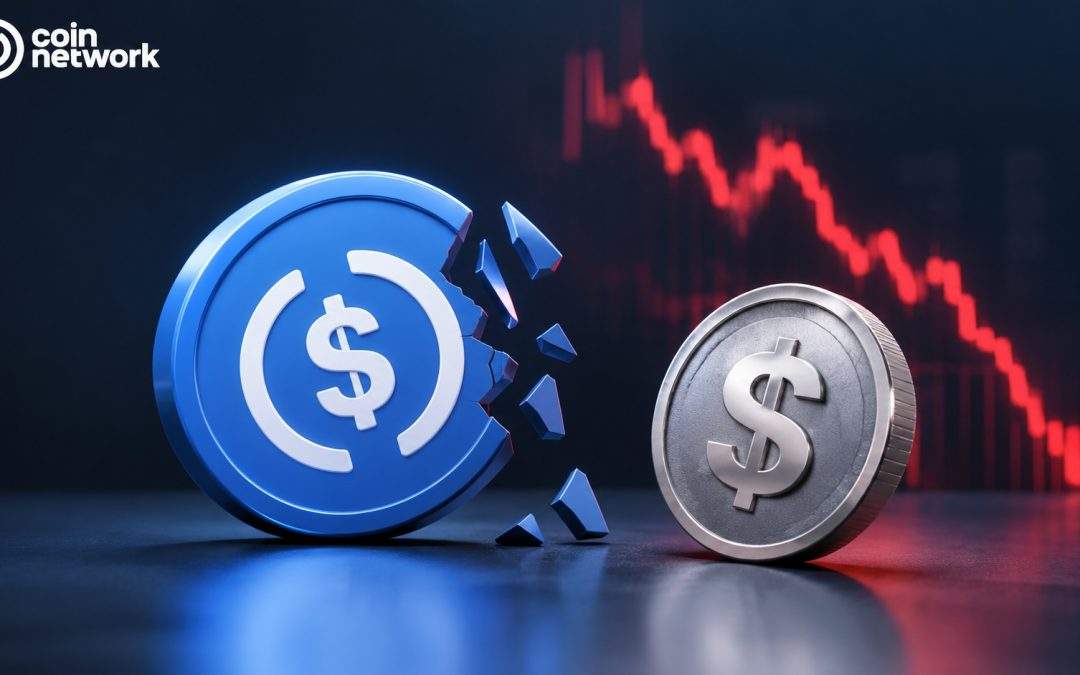
Stablecoin Depegging: What Causes a Dollar-Peg to Break
Stablecoin Depegging: What Does It Mean?
Stablecoin Depegging occurs when a token designed to maintain a value close to $1 moves materially above or below that reference price.
A stablecoin may trade at $0.99, $0.95, or substantially lower during a stress event. It can also trade above $1 when demand for the token exceeds the available market supply or when local liquidity conditions create a premium.
A temporary difference of a few basis points does not necessarily represent a structural failure. Stablecoins trade across multiple exchanges, blockchains, liquidity pools, and markets, so small deviations can occur during normal trading.
A more serious depeg can emerge when market participants lose confidence in the issuer, reserve assets, redemption mechanism, collateral, or smart-contract system.
The core question is:
Why are market participants no longer willing or able to exchange the stablecoin for approximately $1?
How a Dollar-Peg Is Supposed to Work
The mechanics depend on the type of stablecoin.
A fiat-backed stablecoin generally relies on reserves such as cash, Treasury bills, bank deposits, or other highly liquid assets. The issuer creates tokens when users provide the required assets and redeems tokens when users return them.
For example, Circle states that USDC is designed to be redeemable 1:1 for U.S. dollars and that its reserves consist of cash and cash-equivalent assets. Circle’s current transparency page publishes reserve information and issuance and redemption data.
Other stablecoins use different models.
Fiat-Backed Stablecoins
These rely primarily on off-chain reserves and an issuer or redemption system.
Crypto-Backed Stablecoins
These use cryptocurrency collateral, often with excess collateral to absorb price movements.
Algorithmic or Hybrid Stablecoins
These attempt to maintain their target value through market incentives, collateral structures, trading mechanisms, or combinations of these systems.
Because the underlying mechanisms differ, the causes and severity of a depeg can also differ.
Stablecoin Depegging Caused by Reserve Concerns
One of the most important potential causes of Stablecoin Depegging is uncertainty about reserves.
If holders believe that the issuer does not have enough high-quality assets to meet redemptions, they may rush to sell the stablecoin before other holders do.
This can create a feedback loop:
Reserve concerns → increased redemptions → reduced confidence → more selling → greater price pressure
The market does not necessarily need proof of an actual reserve shortfall. A sudden loss of confidence can itself create significant liquidity pressure.
This is why reserve transparency, redemption arrangements, custody, and asset quality are important components of stablecoin risk analysis.
Stablecoin Depegging and Redemption Pressure
A stablecoin’s peg depends partly on arbitrage.
If a token trades at $0.98 but can reliably be redeemed for $1, an eligible market participant may have an incentive to buy the token at $0.98 and redeem it for $1.
That process can help bring the market price closer to its target.
However, arbitrage only works efficiently when redemption is accessible and sufficiently fast.
Problems can arise when:
- Redemption is restricted
- Redemptions have delays
- Certain users cannot redeem directly
- Banking rails are disrupted
- Market makers lack liquidity
- Redemption costs become significant
A stablecoin can therefore remain below $1 longer when the normal arbitrage mechanism is impaired.
Stablecoin Depegging and Liquidity Shocks
Liquidity is another major factor.
A stablecoin may have substantial total market capitalization but still experience temporary price dislocations in specific trading pools or regions.
A thin order book or shallow decentralized-exchange pool can amplify a relatively modest sell order.
This became visible in June 2026 when USDT traded at a premium of more than 8.5% over its dollar reference price on some Indian crypto platforms after enforcement actions disrupted parts of the local supply pipeline. CoinDesk’s June 2026 report on the Indian USDT premium described the event as a local liquidity and supply disruption rather than a failure of USDT’s global dollar peg.
This example is important because not every deviation from $1 has the same cause.
A regional premium can result from fragmented liquidity even when the global market continues trading close to $1.
Stablecoin Depegging During Crypto Market Stress
Large market sell-offs can increase stablecoin volatility indirectly.
During periods of extreme crypto-market stress:
- Traders may rush into stablecoins
- Crypto-backed collateral can fall sharply
- DeFi positions can be liquidated
- Liquidity providers can withdraw capital
- Market makers can reduce risk
- Borrowing costs can change
- Stablecoin redemptions can accelerate
For crypto-backed systems, falling collateral values can be particularly important because the stablecoin’s backing may itself be volatile.
A collateralized stablecoin may therefore require liquidation mechanisms or additional collateral to maintain its target.
Stablecoin Depegging and Collateral Liquidations
Crypto-backed stablecoins often depend on collateral being worth more than the stablecoins issued against it.
Suppose a protocol issues $100 million of stablecoins against $150 million of volatile crypto collateral.
If collateral falls sharply, the safety buffer becomes smaller.
The protocol may then liquidate collateral to maintain the required backing ratio.
If liquidations occur during a market-wide sell-off, liquidity can become more difficult to obtain precisely when it is most needed.
This can increase the risk of further price dislocations.
The specific risk depends on the collateral type, liquidation rules, oracle design, and available liquidity.
Stablecoin Depegging and Smart Contract Exploits
A stablecoin can also lose its target price because of a technical exploit.
In March 2026, the Resolv USR stablecoin experienced a severe depeg after an attacker exploited weaknesses in its minting system. CoinDesk reported that the attacker created about 80 million unbacked USR tokens and extracted roughly $25 million in ETH. USR fell to around $0.02 at one point and was trading well below $1 afterward. CoinDesk’s March 2026 report on the Resolv incident described missing mint limits, inadequate validation, and privileged-account weaknesses as important parts of the incident.
The event illustrates an important point:
Stablecoin Depegging can result from smart-contract failures even when the original problem is not a traditional reserve shortage.
The actual risk depends on the architecture of the stablecoin.
Stablecoin Depegging and Oracle Failures
Some DeFi stablecoins depend on price oracles to determine collateral values, liquidation thresholds, or minting conditions.
An inaccurate, manipulated, delayed, or unavailable oracle can cause a protocol to make incorrect decisions.
Potential consequences can include:
- Excessive minting
- Improper liquidations
- Under-collateralized positions
- Incorrect collateral valuations
- Market dislocations
Oracle dependency is therefore especially important for decentralized stablecoins and other collateral-based protocols.
Users should examine which oracle providers a stablecoin uses and what happens if those feeds become unavailable or manipulated.
Stablecoin Depegging and Exchange Liquidity
Stablecoins trade on centralized exchanges, decentralized exchanges, peer-to-peer markets, and payment platforms.
Their prices can therefore differ temporarily between venues.
A large exchange withdrawal, liquidity-provider exit, market-maker reduction, or regional disruption can cause one venue to show a more significant deviation than another.
The broader stablecoin market has become large enough that liquidity fragmentation matters.
CoinDesk Research reported that the total stablecoin market capitalization reached approximately $311 billion at the end of August 2026, up 1.19% during the month. The same report noted that USDT remained the largest stablecoin and that euro stablecoins also reached a record market capitalization. CoinDesk’s August 2026 stablecoin report provides the market data and methodology.
A separate September 25, 2026 market snapshot from Stablecoin Beat placed total tracked stablecoin capitalization at approximately $304.8 billion, with USDT around $183.8 billion and USDC around $75.3 billion. Stablecoin Beat’s market-cap dashboard provides the underlying time-series data.
The difference between the two figures reflects different dates, datasets, and measurement methods rather than necessarily indicating a market collapse.
Stablecoin Depegging and USDC Scale in 2026
USDC provides a useful example of how large the stablecoin sector has become.
Circle reported that USDC circulation reached $73.3 billion at the end of Q2 2026, representing 19% year-over-year growth. Circle also reported $14.8 trillion in USDC on-chain transaction volume during Q2 2026, a 151% year-over-year increase. Circle’s Q2 2026 results provide the company-reported figures.
By September 24, Circle’s transparency page showed approximately $75.2 billion of USDC in circulation. Circle’s latest USDC transparency information provides the current reserve and circulation disclosures.
These figures demonstrate why stablecoin confidence matters beyond individual trading pairs: stablecoins function as major settlement and liquidity instruments across crypto markets.
How Stablecoin Depegging Can Become a Feedback Loop
A serious depeg can become self-reinforcing.
Consider a simplified sequence:
- Investors become concerned about reserves.
- More holders sell the stablecoin.
- Market liquidity becomes thinner.
- The price falls farther below $1.
- Arbitrage becomes harder or slower.
- Redemptions accelerate.
- Confidence falls further.
This is sometimes described as a run dynamic.
The exact mechanism differs between stablecoins, but the common feature is that confidence and liquidity can reinforce each other.
Stablecoin Depegging: Temporary vs Structural
Not every depeg has the same significance.
Temporary Depeg
The token briefly moves away from $1 due to market volatility, liquidity imbalance, or a short-lived operational issue and subsequently returns toward the target.
Persistent Depeg
The token remains materially below its target for an extended period because the underlying mechanism cannot restore the peg effectively.
Structural Failure
The stablecoin’s reserve, collateral, smart contracts, redemption mechanism, or economic design can no longer support the intended target.
This distinction is important when analyzing market events.
A token trading at $0.997 for several minutes is fundamentally different from a stablecoin trading at $0.40 because a protocol no longer has sufficient backing.
How to Monitor Stablecoin Depegging
A useful monitoring framework includes:
- Price: How far is the token from $1?
- Duration: How long has the deviation lasted?
- Liquidity: How deep are the major markets?
- Redemptions: Are holders redeeming unusually quickly?
- Reserves: Are reserve assets adequate and transparent?
- Collateral: Is collateral falling in value?
- Exchange flows: Are large balances moving toward trading venues?
- Smart contracts: Are there unusual minting or redemption events?
- Oracles: Are price feeds functioning normally?
- Issuer operations: Are banking or redemption channels working?
- Regional markets: Is the deviation global or limited to one venue?
For broader crypto risk education, Coin Network’s Cryptopedia resources can be combined with its DeFi coverage when researching collateral, liquidity, and protocol mechanics.
Common Mistakes When Analyzing Stablecoin Depegging
Treating Every Deviation as a Collapse
Small temporary movements can occur because stablecoins trade on fragmented markets.
Looking Only at Price
A price chart does not explain why the deviation occurred.
Ignoring Redemption Access
A stablecoin can appear liquid on exchanges while its underlying redemption mechanism is impaired.
Assuming All Stablecoins Have the Same Risk
Fiat-backed, crypto-backed, and algorithmic designs have different failure modes.
Ignoring Local Markets
A stablecoin can trade above or below $1 in one country while remaining close to its target globally.
Assuming Reserves Equal Instant Liquidity
Reserve quality matters, but the composition, custody, availability, and redemption process also affect how quickly backing can support the peg.
Stablecoin Depegging: Practical Checklist
Before judging a potential depeg, check:
- Price: How large is the deviation?
- Duration: Is it minutes, hours, or days?
- Volume: Is trading activity unusually high?
- Liquidity: Are major pools deep enough?
- Reserves: What assets back the token?
- Redemption: Can eligible users redeem normally?
- Collateral: Has backing value fallen?
- Minting: Are unexpected tokens being created?
- Oracles: Are price feeds functioning?
- Smart contracts: Has unusual contract activity occurred?
- Exchange flows: Are holders moving large balances?
- Geography: Is the premium or discount global or regional?
Conclusion
Stablecoin Depegging occurs when a dollar-pegged token moves materially away from its intended $1 reference value.
The causes can range from reserve concerns and redemption pressure to liquidity shortages, collateral losses, oracle failures, smart-contract exploits, banking disruptions, and broader market stress.
The 2026 market provides several useful examples. USDT experienced a significant premium on some Indian platforms after local supply channels were disrupted, while the Resolv USR incident demonstrated how a smart-contract exploit can create a much more severe and persistent depeg.
At the same time, the overall stablecoin market remained large, with CoinDesk Research reporting approximately $311 billion in stablecoin market capitalization at the end of August 2026.
The most important lesson is that a stablecoin’s price alone does not tell the full story.
To assess a potential depeg, researchers should examine reserves, redemption mechanisms, liquidity, collateral, smart-contract activity, market structure, and the duration of the price deviation.
The key question is not simply:
“Is the stablecoin below $1?”
It is:
“Why did the peg move, and does the mechanism exist to restore it?”
FAQs
1. What is Stablecoin Depegging?
Stablecoin Depegging occurs when a stablecoin designed to maintain a target value, such as $1, trades materially above or below that target.
2. What causes a stablecoin to depeg?
Common causes include reserve concerns, redemption pressure, low liquidity, collateral losses, smart-contract exploits, oracle problems, banking disruptions, and sudden market stress.
3. Is a stablecoin trading at $0.99 automatically failing?
No.
A short-lived deviation can result from normal market liquidity conditions. Duration, liquidity, redemption access, and the underlying cause are important.
4. Can a stablecoin trade above $1?
Yes.
Strong local demand, liquidity shortages, exchange-specific conditions, or restrictions on supply can cause a stablecoin to trade at a premium.
5. What happened to USDT in India in 2026?
In June 2026, USDT reportedly traded at a premium of more than 8.5% on some Indian crypto platforms after enforcement actions disrupted parts of the local supply pipeline. The event was primarily a regional liquidity and supply disruption rather than evidence of a global USDT reserve failure.
6. Can smart-contract exploits cause Stablecoin Depegging?
Yes.
The March 2026 Resolv USR incident demonstrated this possibility. An attacker exploited weaknesses in the minting infrastructure and created approximately 80 million unbacked tokens, causing USR to fall sharply below its target.
7. Why are stablecoin reserves important?
For reserve-backed stablecoins, reserves are part of the mechanism used to support issuance and redemption.
Reserve quality, liquidity, custody, transparency, and redemption access can all affect market confidence.
8. What is the difference between a temporary and permanent depeg?
A temporary depeg may result from a short-term liquidity or market imbalance and recover toward $1.
A persistent depeg can indicate that the stablecoin’s backing, redemption mechanism, or economic design is no longer restoring the target effectively.
9. How can I monitor a potential stablecoin depeg?
Track the token’s price across multiple venues, trading liquidity, redemption activity, reserve disclosures, collateral levels, unusual minting, exchange flows, and smart-contract events.
10. Does a larger stablecoin market cap make depegging impossible?
No.
A larger market can provide greater liquidity and adoption, but it does not eliminate reserve, redemption, liquidity, technical, or market-structure risks.
11. Which stablecoins are the largest in 2026?
USDT remains the largest stablecoin by market capitalization, while USDC is the second-largest among major dollar-backed stablecoins. September 2026 market data puts USDT near $184 billion and USDC near $75 billion in supply.
12. Where can I learn more about stablecoin and DeFi risks?
Coin Network’s Cryptopedia provides broader blockchain education, while its DeFi section covers decentralized-finance concepts related to collateral, liquidity, and protocol risk.